

Speed moderation. Cases. is one of the topics in the Vehicle movement block of the Spanish DGT theory. How vehicles must move on the road: direction of travel, position on the carriageway, speed and distances. Understanding this section well helps you answer the theory-exam questions on this topic with confidence.
In practice, this comes down to the following:
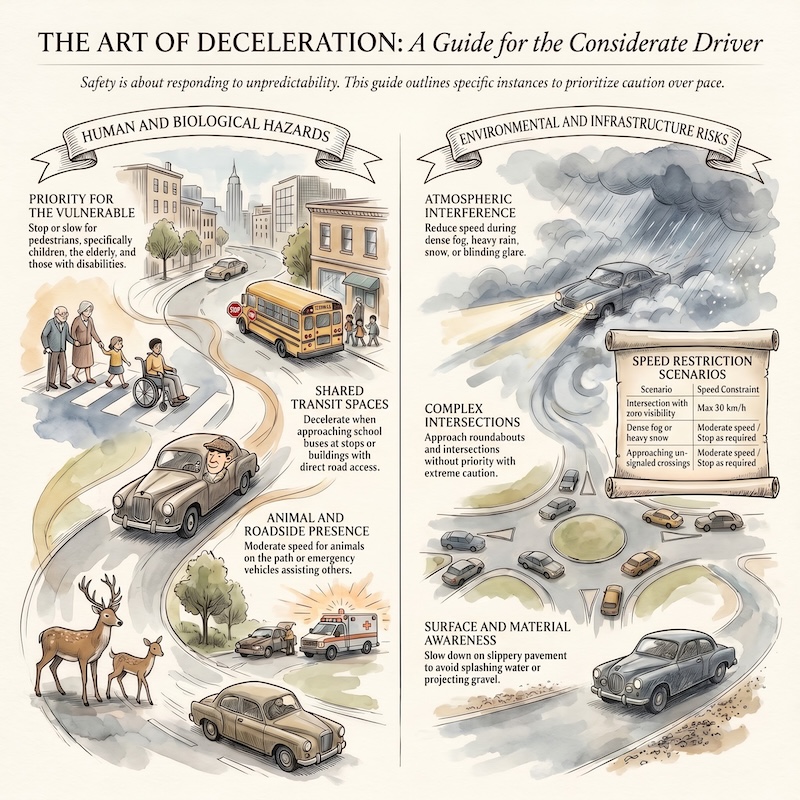
- When there are pedestrians on the part of the road being used or their entry into it can be rationally foreseen, especially if they are children, the elderly, the blind or other clearly disabled persons.
- When approaching bicycles in circulation, as well as at intersections and in the vicinity of roads exclusively for bicycles and pedestrian crossings not regulated by traffic lights or traffic agents, as well as when…
- When there are animals in the part of the road that is being used or their entry into it can be rationally foreseen.
- In sections with buildings with immediate access to the part of the road being used.
- When approaching a stopped bus, especially if it is a school bus.
- Outside of towns when approaching vehicles stopped on the road, assistance vehicles providing service and bicycles circulating on it or on its shoulder.
In short, the rule makes sure every road user knows what to expect in this situation.
Questions here combine speed, lane position and distances: always check whether the road is urban or interurban.
Drive at a moderate speed and, if necessary, stop the vehicle when circumstances so require, especially in the following cases:
- When there are pedestrians on the part of the road being used or their entry into it can be rationally foreseen, especially if they are children, the elderly, the blind or other clearly disabled persons.
- When approaching bicycles in circulation, as well as at intersections and in the vicinity of roads exclusively for bicycles and pedestrian crossings not regulated by traffic lights or traffic agents, as well as when approaching markets, educational centres or places where the presence of children is foreseeable.
- When there are animals in the part of the road that is being used or their entry into it can be rationally foreseen.
- In sections with buildings with immediate access to the part of the road being used.
- When approaching a stopped bus, especially if it is a school bus.
- Outside of towns when approaching vehicles stopped on the road, assistance vehicles providing service and bicycles circulating on it or on its shoulder.
- When driving on slippery pavement or when water, gravel or other materials may be splashed or projected at other road users.
- When approaching level crossings, roundabouts and intersections where priority is not granted, areas with reduced visibility or narrow areas.
If intersections are properly marked and visibility of the road is practically zero, the speed of vehicles must not exceed 50 kilometres per hour.
- When crossing with another vehicle, when the circumstances of the road, the vehicles, or the weather or environment do not allow this to be done safely.
- In case of glare, in accordance with the provisions of article 102.3.
- In cases of dense fog, heavy rain, snow or clouds of dust or smoke.
❓ Frequently asked questions
What is speed moderation. cases.?
Does this topic appear in the DGT theory exam?
Where is it regulated (Article 46 (1))?
🚦 Practise with DGT tests
Already studied the theory? Test yourself with official exam-style questions.
📝 Start with TraficoTest