

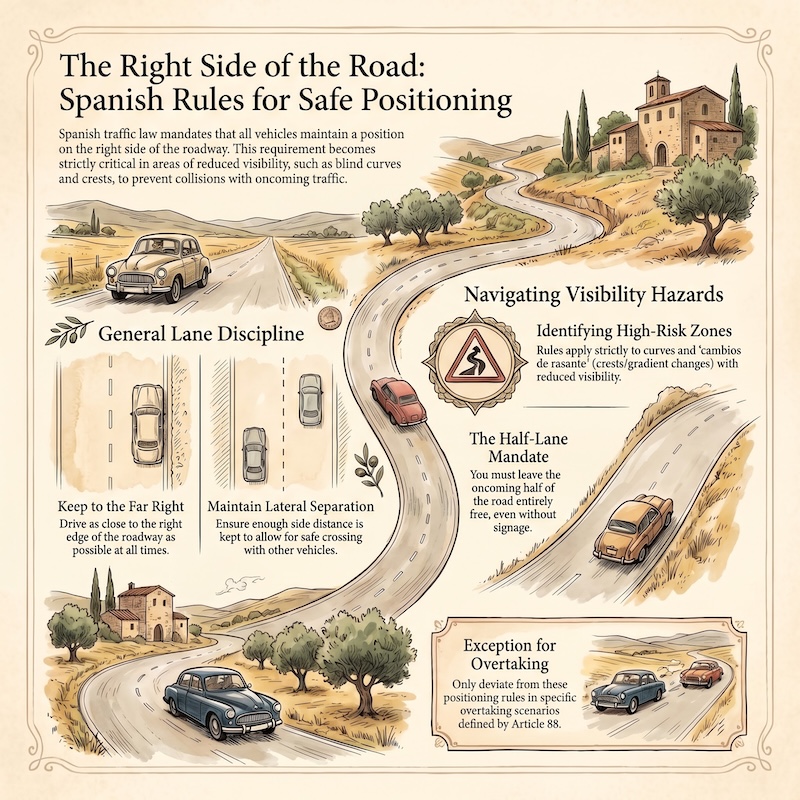
Direction of traffic is one of the topics in the Vehicle movement block of the Spanish DGT theory. How vehicles must move on the road: direction of travel, position on the carriageway, speed and distances. Understanding this section well helps you answer the theory-exam questions on this topic with confidence.
In simple terms, this point of the DGT theory establishes that as a general rule, and especially on curves and changes in elevation with reduced visibility, vehicles must circulate on all roads covered by the Law on traffic, circulation of motor vehicles and road safety on the right and as close as possible to the edge of the road, maintaining sufficient lateral separation to safely cross. Even when there is no express…
Questions here combine speed, lane position and distances: always check whether the road is urban or interurban.
As a general rule, and especially on curves and changes in elevation with reduced visibility, vehicles must circulate on all roads covered by the Law on traffic, circulation of motor vehicles and road safety on the right and as close as possible to the edge of the road, maintaining sufficient lateral separation to safely cross.
Even when there is no express signage delimiting them, in changes of gradient and curves with reduced visibility, all drivers, except in the cases of overtaking provided for in article 88, must leave completely free the half of the roadway that corresponds to those who can travel in the opposite direction.
🔗 Read the official text on the BOE (Spanish General Traffic Regulations)❓ Frequently asked questions
What is direction of traffic?
Does this topic appear in the DGT theory exam?
Where is it regulated (Article 29 (1))?
🚦 Practise with DGT tests
Already studied the theory? Test yourself with official exam-style questions.
📝 Start with TraficoTest