

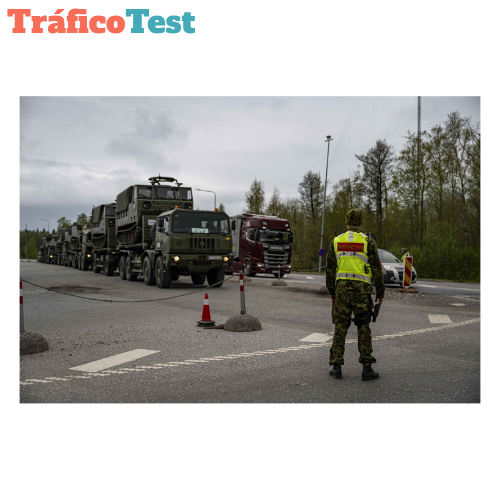
Rules and conditions of circulation of special vehicles and vehicles under special transport regime is one of the topics in the Other rules block of the Spanish DGT theory. Complementary rules on specific traffic situations that complete the theory. Understanding this section well helps you answer the theory-exam questions on this topic with confidence.
In practice, this comes down to the following:
- Military authority ordering the movement: the person legally authorized to sign the document authorizing transportation, determining the mode and conditions of movement and, where appropriate, the body designated to…
- Convoy leader: personnel who are part of a convoy and exercise authority over it.
- Head of transport: the head of the means of transport that make up the military column and the technical manager.
- Military column: a group of vehicles moving under a single column leader along the same route, at the same time, and in the same direction. Columns may be composed of several organized elements called "convoys" or…
- Convoy: any group of vehicles consisting of at least three units, two of which will be the lead and tail signal vehicles. These lead and tail vehicles must display the V-2 signal (as set out in Annex XI, signal V-2, of…
In short, the rule makes sure every road user knows what to expect in this situation.
These are specific rules that round off the theory; read them closely, as the nuance often decides the correct answer.
Section 2. Specific regime for the movement of military convoys and columns, special transport of military material in vehicles belonging to the Ministry of Defense or in the service of NATO's international military headquarters
- For the purposes of this section, the following definitions apply:
- Military authority ordering the movement: the person legally authorized to sign the document authorizing transportation, determining the mode and conditions of movement and, where appropriate, the body designated to manage the movement.
- Convoy leader: personnel who are part of a convoy and exercise authority over it.
- Head of transport: the head of the means of transport that make up the military column and the technical manager.
- Military column: a group of vehicles moving under a single column leader along the same route, at the same time, and in the same direction. Columns may be composed of several organized elements called "convoys" or "marching units."
- Convoy: any group of vehicles consisting of at least three units, two of which will be the lead and tail signal vehicles. These lead and tail vehicles must display the V-2 signal (as established in Annex XI, signal V-2, of the General Vehicle Regulations, approved by Royal Decree 2822/1998, of December 23).
- The movement of military vehicles, columns, and convoys shall be carried out in such a way as to avoid obstructing other users as much as possible. Except in urgent cases, the military authority ordering the movement shall notify the autonomous body, the Central Traffic Headquarters, at least 48 hours in advance of the route and planned schedule.
In emergency situations, this communication will be made directly to the Traffic Management Center of the central services of the General Directorate of Traffic.
The convoy leader shall oversee and be responsible for ensuring that the movement is carried out in accordance with the provisions of this section and the rest of the regulations implementing the consolidated text of the Law on Traffic, Motor Vehicle Circulation, and Road Safety, and shall especially ensure that both drivers and vehicles carry the required documentation.
- The circulation of special vehicles and vehicles operating under special transport regime will not require the authorization provided for in Article 14 of the General Vehicle Regulations, and will be carried out in all cases under the responsibility of the military authority ordering the movement.
The prohibition contained in Article 18.2 of this regulation is exempt from drivers of military vehicles that, due to their nature, require an internal communications system.
🔗 Read the official text on the BOE (Spanish General Traffic Regulations)❓ Frequently asked questions
What is rules and conditions of circulation of special vehicles and vehicles under special transport regime?
Does this topic appear in the DGT theory exam?
Where is it regulated (ANEXO III. Sección 2)?
🚦 Practise with DGT tests
Already studied the theory? Test yourself with official exam-style questions.
📝 Start with TraficoTest