

Driving on motorways, dual carriageways and other roads is one of the topics in the Vehicle movement block of the Spanish DGT theory. How vehicles must move on the road: direction of travel, position on the carriageway, speed and distances. Understanding this section well helps you answer the theory-exam questions on this topic with confidence.
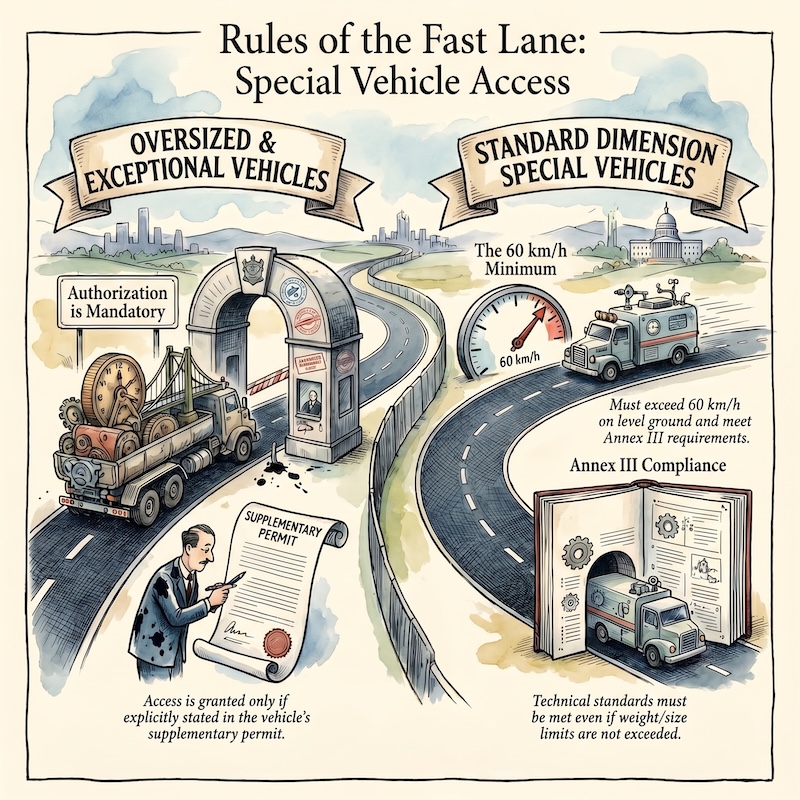
In simple terms, this point of the DGT theory establishes that special vehicles or vehicles under special transport regime that exceed the masses or dimensions set out in the General Vehicle Regulations may, exceptionally, circulate on motorways and dual carriageways when so indicated in the complementary authorisation with which they must be provided, and those that do not exceed said masses or dimensions, when…
Questions here combine speed, lane position and distances: always check whether the road is urban or interurban.
Special vehicles or vehicles under special transport regime that exceed the masses or dimensions established in the General Vehicle Regulations may, exceptionally, circulate on motorways and dual carriageways when so indicated in the complementary authorisation with which they must be provided, and those that do not exceed said masses or dimensions, when, according to their characteristics, they can develop a speed greater than 60 km/h on flat ground and meet the conditions indicated in Annex III of this regulation.
🔗 Read the official text on the BOE (Spanish General Traffic Regulations)❓ Frequently asked questions
What is driving on motorways, dual carriageways and other roads?
Does this topic appear in the DGT theory exam?
Where is it regulated (Article 38 (3))?
🚦 Practise with DGT tests
Already studied the theory? Test yourself with official exam-style questions.
📝 Start with TraficoTest