

The signs in the «Complementary panels» group belong to the VII. Vertical traffic signs block of the Spanish DGT theory. It is an information sign: rectangular or square, usually with a blue background.
On this page you have the complete catalogue of these signs with their image, official code and meaning, exactly as they may appear in the driving-licence theory exam.
💡 In the exam you will be shown the image of the sign and must recognise its meaning: look at the shape and colour to work out which group it belongs to.
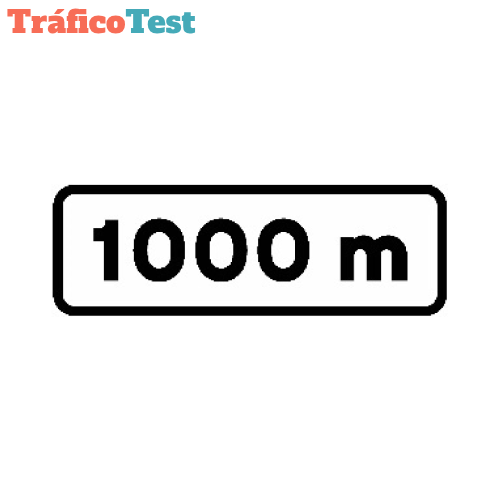 S-800
S-800
Distance to the beginning of the danger or prescription
Indicates the distance from the place where the sign is located to the place where the danger begins or the prescription of the sign begins to apply. In the case that it is placed under the sign warning of danger due to narrowing of the road, it may indicate the clear width of the said narrowing.
Article 163
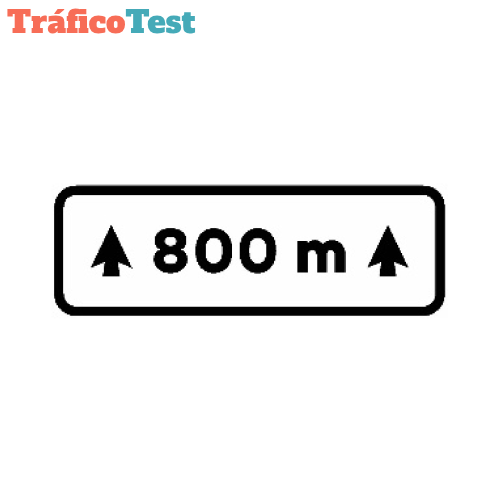 S-810
S-810
Length of dangerous or prescribed section
Indicates the length where the danger exists or where the prescription applies.
Article 163
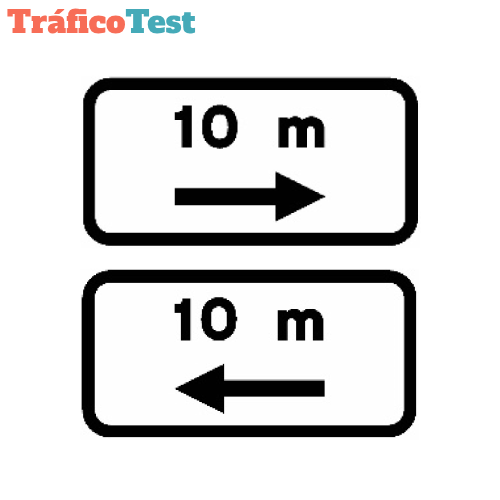 S-820y
and S-821
Prohibition extension, to one side. Placed under a prohibition sign, it indicates the distance over which this prohibition applies in the direction of the arrow.
Article 163
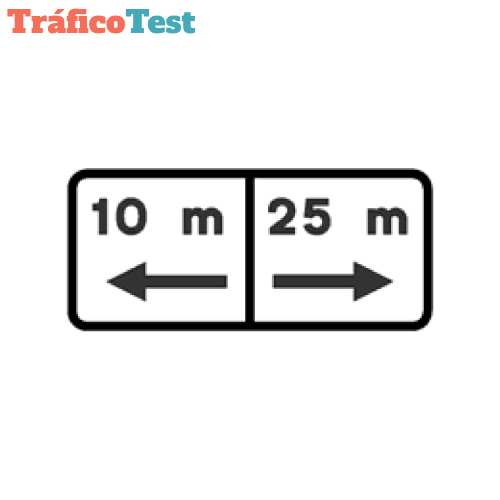 S-830
S-830
Extension of the prohibition, on both sides
Placed under a prohibition sign, it indicates the distances in which this prohibition applies in each direction indicated by the arrows.
Article 163
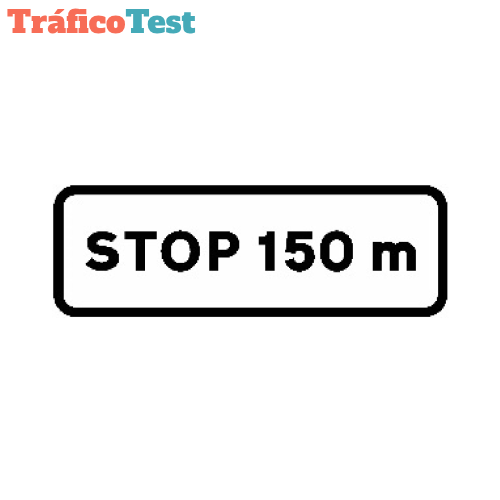 S-840
S-840
Mandatory stop pre-signaling
Placed under the yield sign, it indicates the distance to the mandatory stop sign at the next intersection.
Article 163
 S-850a
to S-853
Priority route. Additional panel of the R-3 sign, indicating the priority route.
Article 163
 S-860
S-860
Generic
Panel for any other clarification or delimitation of the signal or traffic light under which it is placed.
Article 163
 S-870a
Signage application
Indicates, below the corresponding vertical sign, that it applies only to the exit ramp whose direction approximately matches that of the arrow.
Article 163
 S-870b
Signage application
Indicates, below the corresponding vertical sign, that it applies only to the exit ramp whose direction approximately matches that of the arrow.
Article 163
 S-880a
Signage application for trucks
Indicates, below the corresponding vertical sign, that it applies exclusively to trucks.
Article 163
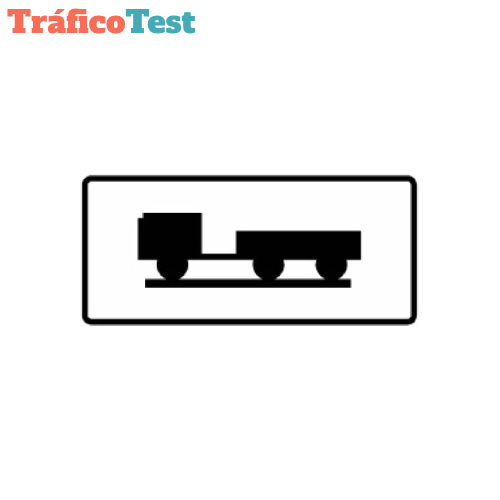 S-880b
Signage application for vehicles with trailers, except those with a single axle
Indicates, below the corresponding vertical sign, that it applies exclusively to vehicles with trailers, except those with a single axle.
Article 163
 S-880c
Signage application for buses
Indicates, below the corresponding vertical sign, that it applies exclusively to buses.
Article 163
 S-880d
Signage application for bicycles
Indicates, below the corresponding vertical sign, that it applies exclusively to bicycles.
Article 163
 S-880e
Signage application for personal mobility vehicles
Indicates, below the corresponding vertical sign, that it applies exclusively to personal mobility vehicles.
Article 163
 S-880f
Signage application for bicycles and personal mobility vehicles
Indicates, below the corresponding vertical sign, that it applies exclusively to bicycles and personal mobility vehicles.
Article 163
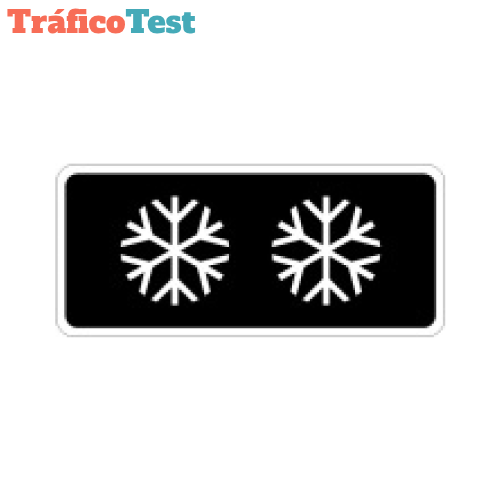 S-890a
Signage application under snowy conditions
Indicates, below the corresponding vertical sign, that it applies only when snowy conditions are present.
Article 163
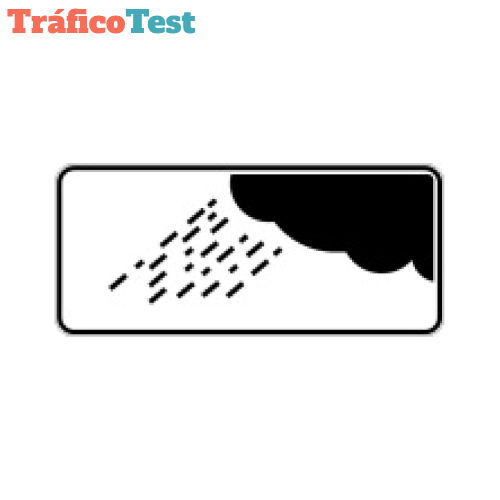 S-890b
Signage application under rainy conditions
Indicates, below the corresponding vertical sign, that it applies only when rainy conditions are present.
Article 163
 S-890c
Signage application under foggy conditions
Indicates, below the corresponding vertical sign, that it applies only when foggy conditions are present.
Article 163
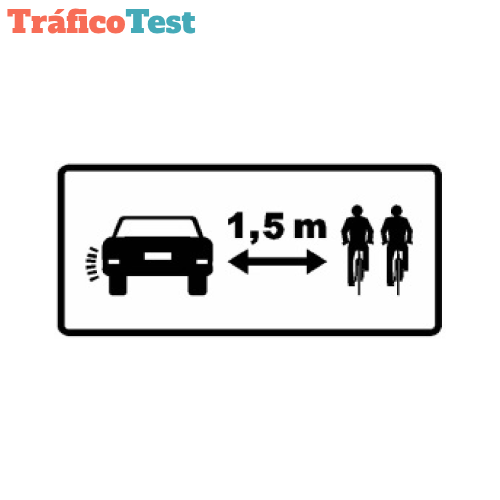 S-891
S-891
Lateral distance when overtaking a cyclist
Indicates, below the corresponding vertical sign, the minimum lateral distance that a vehicle must maintain from the cyclist or group of cyclists being overtaken. If it is a group of cyclists, the distance refers to the cyclist riding furthest to the left.
Article 163
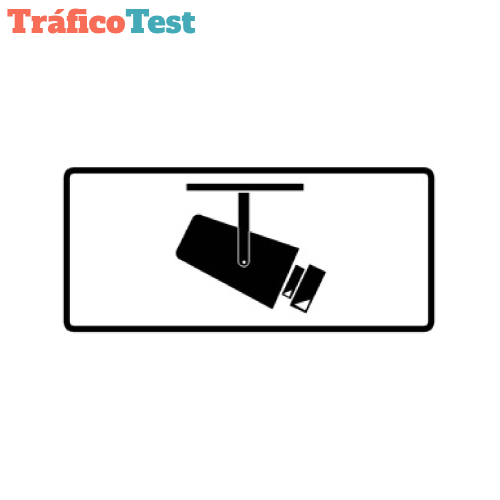 S-892
S-892
Monitoring by automatic means
Indicates that compliance with the vertical sign it accompanies is monitored using automatic detection and enforcement systems.
Article 163
❓ Frequently asked questions
What are «Complementary panels» signs?
How many signs does this group include?
Do these signs appear in the DGT theory exam?
🚦 Practise with DGT tests
Already recognise these signs? Test yourself with official exam-style questions.
📝 Start with TraficoTest