

Circumstantial and beaconing signals is one of the topics in the Traffic signage block of the Spanish DGT theory. How signage works: types of signs, the order of priority between them and the duty to obey them. Understanding this section well helps you answer the theory-exam questions on this topic with confidence.
In practice, this comes down to the following:
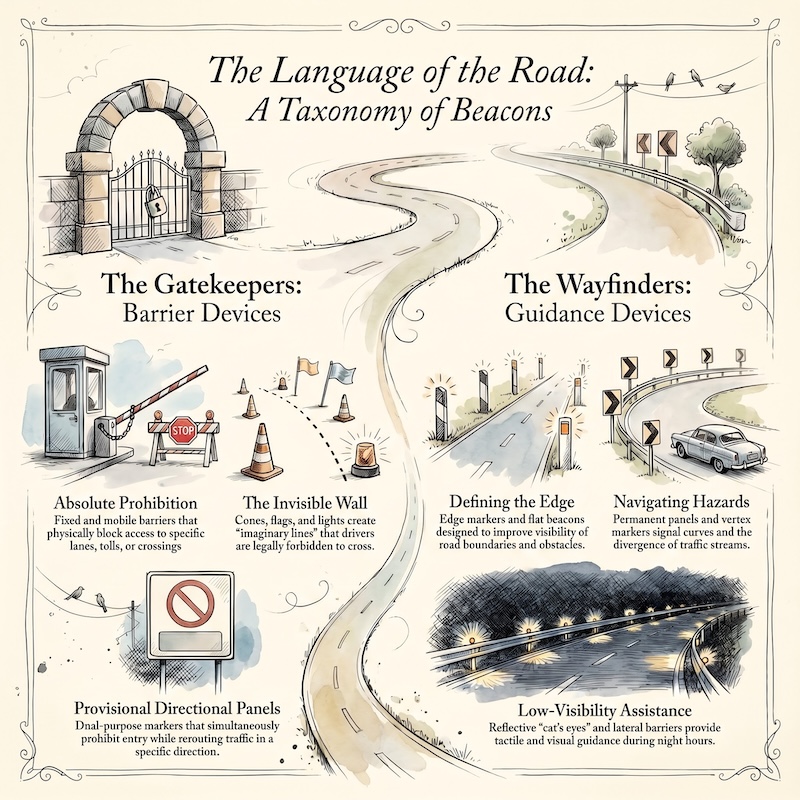
- Barrier devices: they prohibit access to the part of the road they delimit and are the following:
- Guiding devices: their purpose is to indicate the edge of the road, the presence of a curve and the direction of traffic, the limits of masonry works or other obstacles. They are the following:
In short, the rule makes sure every road user knows what to expect in this situation.
The order of priority between signs (officer, traffic light, vertical sign, road marking) is key; many questions are solved just by recalling it.
📜 Reference legal text — Article 144 (2)
The beaconing signals may be:
- Barrier devices: they prohibit access to the part of the road they delimit and are the following:
- Fixed barrier: prohibits access to the road or part of it that it delimits.
- Mobile barrier or semi-barrier: temporarily prohibits passage while in a position transverse to the roadway at a level crossing, toll booth or customs post, access to an establishment or other.
- Temporary directional panel: prohibits passage and also provides information on the direction of traffic.
- Flags, cones or similar devices: they prohibit passage across the real or imaginary line that unites them.
- Fixed red light: indicates that the road is completely closed to traffic.
- Fixed or flashing yellow lights: prohibit passage across the imaginary line that joins them.
- Guiding devices: their purpose is to indicate the edge of the road, the presence of a curve and the direction of traffic, the limits of masonry works or other obstacles. They are the following:
- Vertex marker: a beaconing element with a semi-cylindrical shape on its front face, provided with symmetrically opposed triangles, made of retroreflective material, which indicates the point at which two traffic streams separate.
- Edge marker: element whose primary purpose is to mark the edges of roads mainly during nighttime or low visibility hours.
- Permanent directional panels: beaconing devices installed to guide and indicate to users a specific danger, through which they are informed about the direction of traffic.
- Horizontal reflectors (cat's eyes).
- Barrier reflectors.
- Flat beacons: indicate the edge of the road, the limits of construction works or other obstacles on the road.
- Cylindrical beacons: they reinforce any security measure, and the line, imaginary or not, that connects them cannot be crossed.
- Side barriers: rigid, semi-rigid, and movable. They indicate the edge of the platform and protect against exiting the track.
❓ Frequently asked questions
What is circumstantial and beaconing signals?
Circumstantial and beaconing signals is a DGT theory topic within the «Traffic signage» block, governed by Artículo 144 (2) of the Spanish General Traffic Regulations. Above you will find a simple explanation and the reference legal text.
Does this topic appear in the DGT theory exam?
Yes. Every section of the General Traffic Regulations can appear in the theory exam. To practise with real questions, go to the TraficoTest platform.
Where is it regulated (Article 144 (2))?
This content comes from Article 144 (2) of the Spanish traffic regulations. You can read the official text on the BOE.
🚦 Practise with DGT tests
Already studied the theory? Test yourself with official exam-style questions.
📝 Start with TraficoTest