

Circular traffic lights for vehicles is one of the topics in the Traffic signage block of the Spanish DGT theory. How signage works: types of signs, the order of priority between them and the duty to obey them. Understanding this section well helps you answer the theory-exam questions on this topic with confidence.
In practice, this comes down to the following:
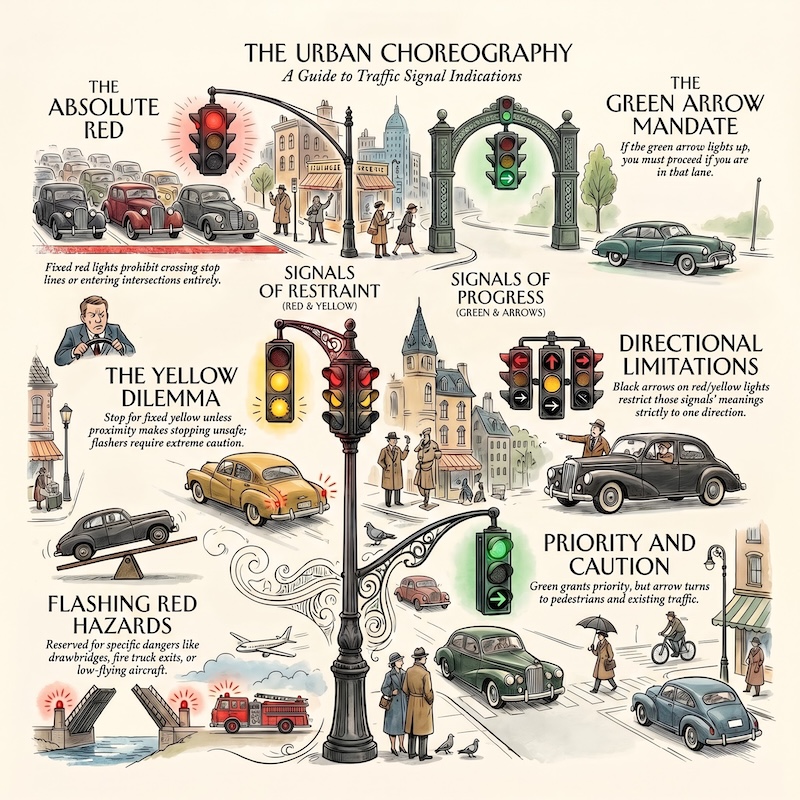
- A non-flashing red light prohibits passage.
- A flashing red light, or two alternately flashing red lights, temporarily prohibit the passage of vehicles before a level crossing, an entrance to a drawbridge or a ferry pontoon, in the vicinity of a fire-fighting…
- A non-flashing yellow light means that vehicles must stop under the same conditions as if it were a steady red light, unless, when it lights up, the vehicle is so close to the stopping place that it cannot stop before…
- A flashing yellow light or two alternately flashing yellow lights require drivers to exercise extreme caution and, where appropriate, to yield. They also do not exempt drivers from complying with other signs requiring…
- A non-flashing green light means that priority passage is permitted, except in the cases referred to in Article 59.1.
- A black arrow over a non-flashing red light or a yellow light does not change the meaning of said lights, but limits it exclusively to the movement indicated by the arrow.
In short, the rule makes sure every road user knows what to expect in this situation.
The order of priority between signs (officer, traffic light, vertical sign, road marking) is key; many questions are solved just by recalling it.
The meaning of its lights and arrows is as follows:
a) A non-flashing red light prohibits passage.
While the signal is on, vehicles must not pass the traffic light or, if it exists, the stop line located before it. If the traffic light is within or on the opposite side of an intersection, vehicles must not enter the intersection or, if it exists, pass the stop line located before it.
b) A flashing red light, or two alternately flashing red lights, temporarily prohibit the passage of vehicles before a level crossing, an entrance to a drawbridge or a ferry pontoon, in the vicinity of a fire-fighting vehicle exit or on the occasion of the approach of a low-altitude aircraft.
c) A non-flashing yellow light means that vehicles must stop under the same conditions as if it were a steady red light, unless, when it lights up, the vehicle is so close to the stopping place that it cannot stop before the traffic light under sufficient safety conditions.
d) A flashing yellow light or two alternately flashing yellow lights oblige drivers to exercise extreme caution and, where appropriate, to give way. In addition, they do not exempt drivers from complying with other signals that require them to stop. As a general rule, at pedestrian crossings with a traffic light reserved for pedestrians, the flashing yellow light for vehicles may not coincide with the steady green light for pedestrians and must be preceded by the steady red light.
e) A non-flashing green light means that priority passage is permitted, except in the cases referred to in Article 59.1.
f) A black arrow over a non-flashing red light or a yellow light does not change the meaning of said lights, but limits it exclusively to the movement indicated by the arrow.
g) A green arrow illuminated on a black circular background means that vehicles may take the direction and sense indicated by it, regardless of the light that is simultaneously on at the same traffic light or at an adjacent one.
Any vehicle that, when the green arrow is lit, is in a lane reserved exclusively for traffic in the direction and directions indicated by the arrow or that, without being reserved, is the one that this traffic must use, must advance in that direction and direction.
Vehicles proceeding following a green arrow must do so with caution, allowing vehicles travelling in the lane they are entering to pass and not endangering pedestrians crossing the road.
🔗 Read the official text on the BOE (Spanish General Traffic Regulations)❓ Frequently asked questions
What is circular traffic lights for vehicles?
Does this topic appear in the DGT theory exam?
Where is it regulated (Article 146 y Anexo I (4.2))?
🚦 Practise with DGT tests
Already studied the theory? Test yourself with official exam-style questions.
📝 Start with TraficoTest