

Arm signals and others is one of the topics in the Traffic signage block of the Spanish DGT theory. How signage works: types of signs, the order of priority between them and the duty to obey them. Understanding this section well helps you answer the theory-exam questions on this topic with confidence.
In practice, this comes down to the following:
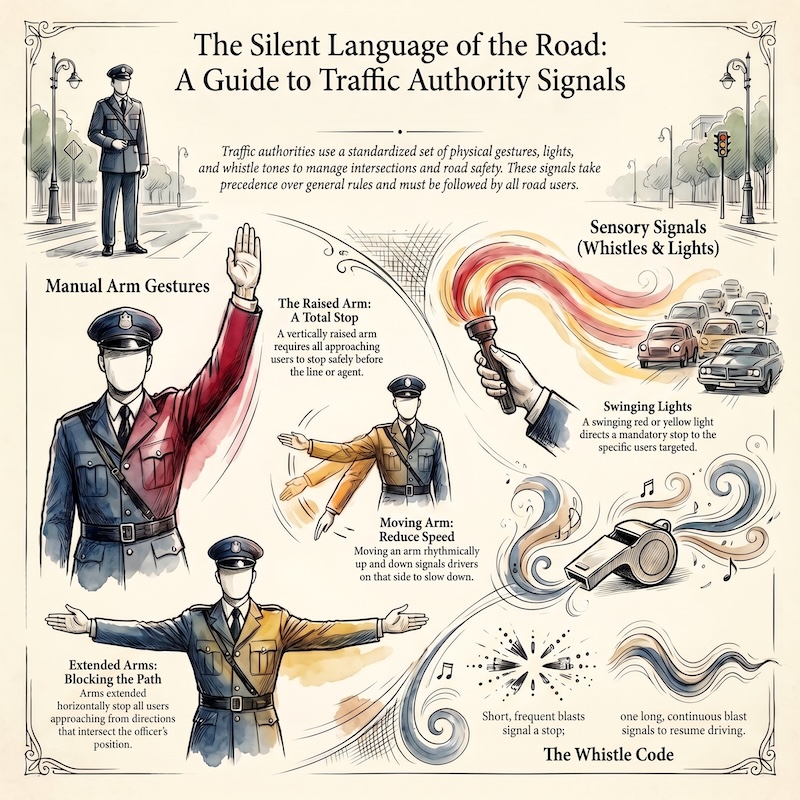
- Arm raised vertically: requires all road users approaching the officer to stop, except for drivers who cannot do so under sufficient safety conditions. If this signal is given at an intersection, it does not require…
- Arm or arms extended horizontally: this requires all road users approaching the officer from directions that intersect with the direction indicated by the extended arm or arms, regardless of the direction of travel, to…
- Swinging a red or yellow light: forces road users towards whom the officer directs the light to stop.
- Arm extended and moving it up and down alternately: this signal requires drivers approaching the officer on the side corresponding to the arm making the signal and perpendicular to said arm to slow down their vehicle.
- Other signals: when circumstances so require, officers may use any other indication other than the above, provided it is made clearly.
In short, the rule makes sure every road user knows what to expect in this situation.
The order of priority between signs (officer, traffic light, vertical sign, road marking) is key; many questions are solved just by recalling it.
As a general rule, the agents of the authority responsible for traffic will use the following signals:
- Arm raised vertically: requires all road users approaching the officer to stop, except for drivers who cannot do so under sufficient safety conditions. If this signal is given at an intersection, it does not require drivers who have already entered the intersection to stop.
The stop must be made at the nearest stop line or, failing that, immediately before the officer. At an intersection, the stop must be made before entering it.
After this signal, the agent may indicate, where appropriate, the place where the arrest must be made.
- Arm or arms extended horizontally: this requires all road users approaching the officer from directions that intersect with the direction indicated by the extended arm or arms, regardless of the direction of travel, to stop. This signal remains in effect even if the officer lowers his arm or arms, provided that he does not change position or give another signal.
- Swinging a red or yellow light: forces road users towards whom the officer directs the light to stop.
- Arm extended and moving it up and down alternately: this signal requires drivers approaching the officer on the side corresponding to the arm making the signal and perpendicular to said arm to slow down their vehicle.
- Other signals: when circumstances so require, officers may use any other indication other than the above, provided it is made clearly.
Officers will be able to order vehicles to stop with a series of short, frequent whistle blasts and to resume driving with a long blast.
🔗 Read the official text on the BOE (Spanish General Traffic Regulations)❓ Frequently asked questions
What is arm signals and others?
Does this topic appear in the DGT theory exam?
Where is it regulated (Article 143 (2))?
🚦 Practise with DGT tests
Already studied the theory? Test yourself with official exam-style questions.
📝 Start with TraficoTest