

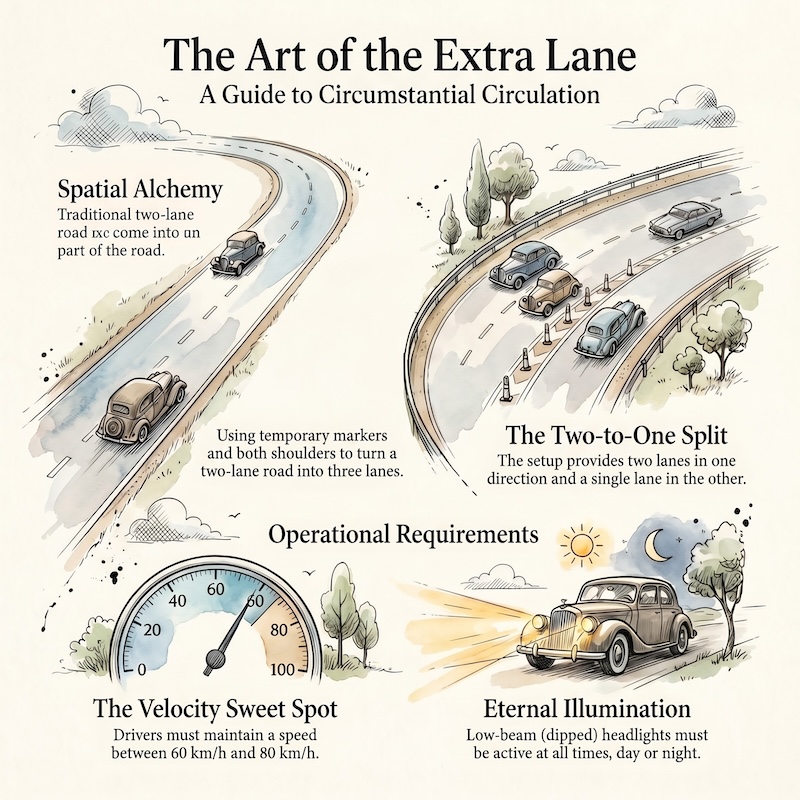
Additional circumstantial traffic lanes is one of the topics in the Vehicle movement block of the Spanish DGT theory. How vehicles must move on the road: direction of travel, position on the carriageway, speed and distances. Understanding this section well helps you answer the theory-exam questions on this topic with confidence.
In simple terms, this point of the DGT theory establishes that on two-way roads and hard shoulders, when the width of the roadbed allows, the authority responsible for traffic regulation may create an additional lane for traffic in one of the directions of traffic, using temporary signage and beaconing elements that modify the rolling area for vehicles in the centre of the road. The creation of this additional lane for…
Questions here combine speed, lane position and distances: always check whether the road is urban or interurban.
On two-way roads and hard shoulders, when the width of the roadbed allows, the authority responsible for traffic regulation may create an additional lane for traffic in one of the directions of traffic, using temporary signage and beaconing elements that modify the rolling area for vehicles in the centre of the road.
The creation of this additional lane for temporary traffic means that, by using both hard shoulders, there are two lanes in one direction of traffic and one in the other. In any case, this circumstance will be duly signposted. Vehicles travelling on the hard shoulders and on this additional lane will do so at a maximum speed of 80 kilometres per hour and a minimum of 60, or less if so established or specifically signposted, they must use at least short-range or dipped headlights both during the day and at night and must observe, as far as applicable, the rules contained in the previous article.
🔗 Read the official text on the BOE (Spanish General Traffic Regulations)❓ Frequently asked questions
What is additional circumstantial traffic lanes?
Does this topic appear in the DGT theory exam?
Where is it regulated (Article 42 (1))?
🚦 Practise with DGT tests
Already studied the theory? Test yourself with official exam-style questions.
📝 Start with TraficoTest