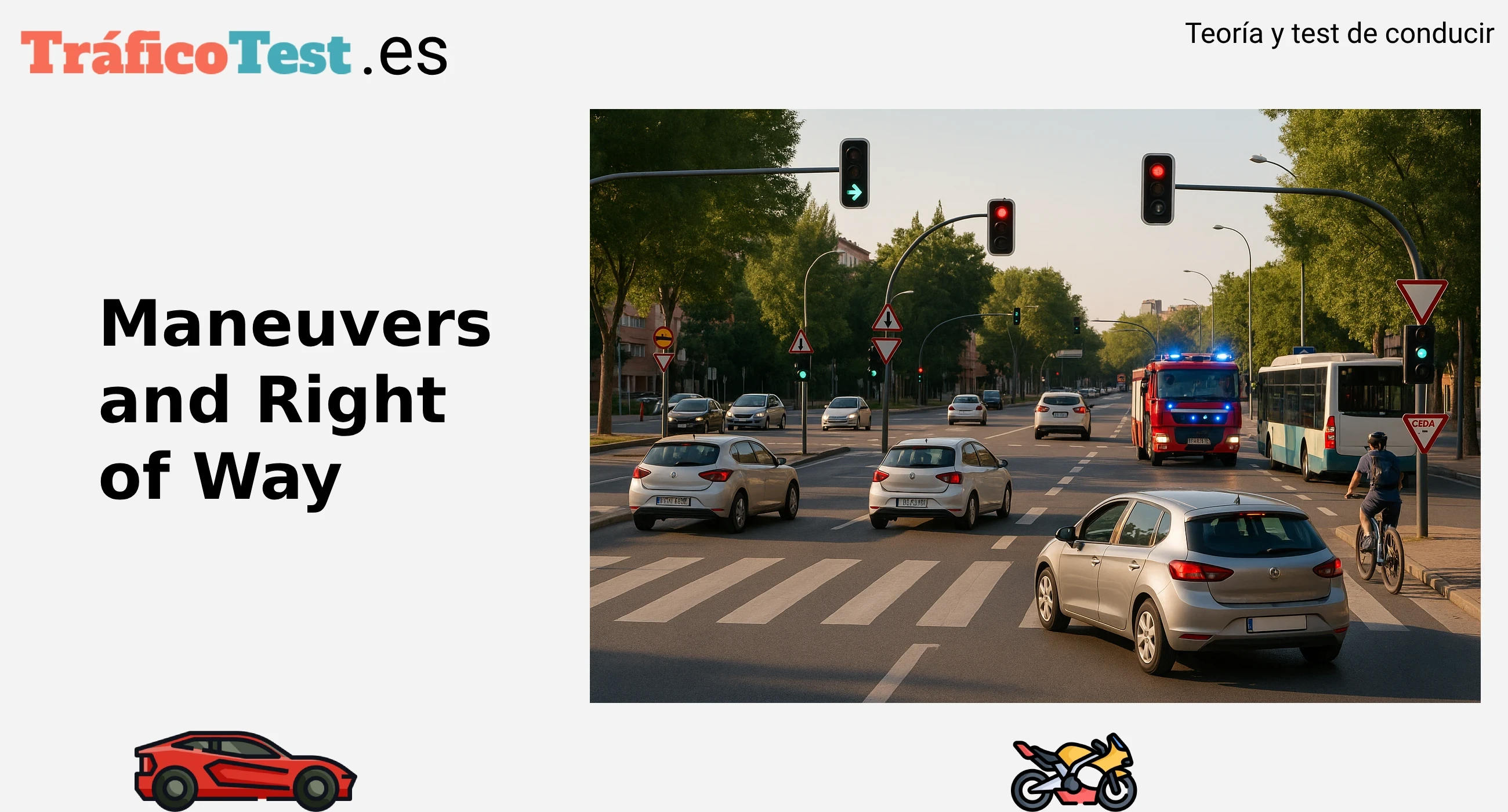
Performing maneuvers correctly and respecting the right of way is essential for road safety. Here we explain how to do it step by step, with examples and clear rules. 🚦
🔍 1. General Rules: O.S.R.
For any maneuver you must follow the O.S.R. rule: Observe, Signal, and Execute.
- 👀 Observe: Use your mirrors; get out of the vehicle if necessary, or ask for help.
- 📢 Signal: With indicators or by hand if needed (you must keep signaling until the maneuver is completed).
- 🚗 Execute: Only if it’s safe and without obstructing others.
📣 Other valid signals
| Type | When to use | Examples |
|---|---|---|
| 🔊 Acoustic (horn) | To prevent accidents or warn | Sharp bends, overtaking |
| 💡 Light (headlight flashes) | To indicate intention | Overtaking, reduced visibility |
🚗 2. Merging into traffic
Always watch the position, speed, and path of other vehicles. Yield if necessary and signal correctly. In built-up areas, allow public transport to pull out from marked stops.
↔️ 3. Lateral movements
Always apply the O.S.R. rule before changing lanes. Yield to the lane you are entering.
🏎️ 4. Overtaking
- ✅ Overtake on the left except for the listed exceptions.
- 📏 When overtaking cyclists, pedestrians, mopeds or e-scooters: leave at least 1.5 m on any road; change lane completely if there is more than one lane per direction; and outside built-up areas drive at least 20 km/h below the road limit (since 1 October 2026, RD 518/2026).
- ⛔ Prohibited on bends, level crossings, one-lane tunnels, intersections, or when visibility is poor.
🚘 Cases when passing on the right is allowed
- When the vehicle ahead is turning left.
- On urban roads with multiple lanes in the same direction.
- When trams run in the center.
🔄 5. Changes of direction
Must be carried out by observing, signaling, and executing without danger. Move toward the appropriate edge of the carriageway depending on the turn. 🚦
🚫 Prohibitions
- When there isn’t sufficient visibility.
- When signs prohibit it.
🔁 6. U-turns
Consist of turning 180° to take the opposite direction. Preferably do it from the shoulder or a designated lane.
- 🚫 Prohibited on one-way roads, where signed, or when visibility is insufficient.
- ✅ Better to do it in roundabouts, traffic islands, or designated areas.
🔙 7. Reversing
Only allowed exceptionally (maximum 15 m). Complementary to maneuvers such as parking or merging.
- 👁️ Check around you, even getting out if necessary.
- 🚦 Stop if another road user approaches.
🛑 8. Immobilizing a moped
- 🔧 Emergency stop: signal with hazard and position lights. Use the SOS post if necessary.
- 🔥 In case of fire in a tunnel: evacuate in the opposite direction to the fire.
- 🚧 It’s prohibited to drive in a tunnel if there is a red light or a barrier.
🅿️ 9. Stopping and parking
Rules depend on whether you are on an urban or interurban road.
- 🚫 Prohibited: double parking, pedestrian crossings, bike lanes, tunnels, roundabouts, driveways, blind bends.
- ✔️ Always leave at least 3 meters free for other vehicles.
🚦 10. Right of way
🛑 At unsigned intersections
🚘 The vehicle coming from the right has priority.
🚊 Special priority
- 🚋 Rail vehicles (trams)
- 🚴♂️ Cyclists on bike lanes, cycle crossings or signed shoulders, when a motor vehicle or moped turns into another road, and groups once the first rider has started crossing or entered a roundabout (priority over all other vehicles, RD 518/2026)
- 🚶♀️ Pedestrians at marked crossings or intersections
- 🐄 Animals on drovers’ roads or crossings
🚓 Emergency vehicles
With lights and siren, they have full priority. Others must facilitate their passage by stopping or moving aside. 🚨
🪧 Narrowings without signs
Priority to the one who arrived first or, if they arrive at the same time:
- The vehicle that is more difficult to maneuver (special, with trailer, public transport…)
- The one that would have to reverse a greater distance
⛰️ Steep gradients
Priority for the vehicle going uphill, unless there is a turnout area to facilitate passing.
🌉 Bridges and overpasses
Signs establish priority. If there are none, apply the narrowing criterion.
Take the test