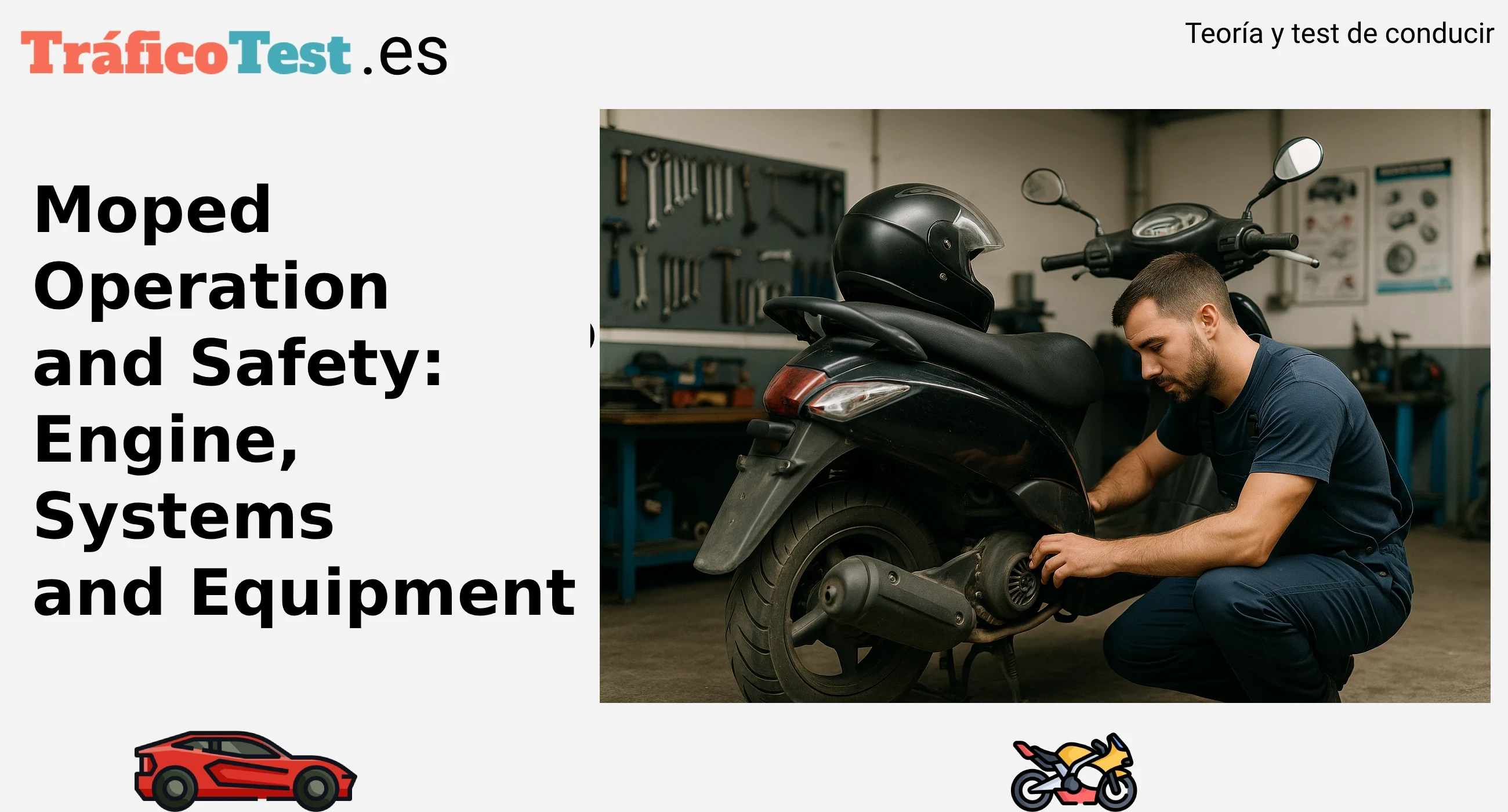
Knowing how your moped works and maintaining it properly not only improves its performance, it also helps prevent accidents and reduces pollution. 🌍🛵
🔥 1. Basic engine information
The engine transforms energy into motion so the vehicle can move. It can be:
- ➡️ Two-stroke: uses a mixture of air, fuel, and oil.
- ➡️ Four-stroke: mixes air and fuel separately.
🛠️ 2. Engine systems
🚀 2.1 Fuel supply system
Supplies air and fuel to the engine. It can include:
- 💨 Air circuit
- ⛽ Fuel circuit
Electronic fuel injection reduces consumption and emissions 🌱.
Maintenance:
- 🔍 Check the air filter (more often in summer).
- ⚙️ Check the idle speed: if it’s high, it uses more fuel; if it’s low, it stalls.
💨 2.2 Exhaust system
Expels gases from the engine to the outside. Components:
- 🔇 Muffler: reduces noise and temperature.
- ♻️ Catalytic converter: reduces toxic gases.
Riding is prohibited if:
- 🚫 The muffler is missing.
- 🚫 It emits excessive smoke or toxic gases.
- 🚫 It makes unnecessary noise (loud music, horn, etc.).
🛢️ 2.3 Lubrication system
Reduces friction between parts. It’s based on oil mixed with the fuel (2T) or in a separate tank.
- ⚠️ Check the oil level when refueling.
- 🟡 Some models have a warning light if oil is low.
❄️ 2.4 Cooling system
Prevents the engine from overheating:
- 🌬️ By direct air
- 🌀 By forced air (fan)
- 💧 By coolant
Maintenance:
- 🧼 Clean the cooling fins (if air-cooled).
- 💧 Check the coolant level (if liquid-cooled).
- 🌡️ Add antifreeze in winter.
🔋 3. Electrical equipment
🔋 3.1 Battery
Provides power when the engine is off.
- 💧 Check the electrolyte level (distilled water and acid).
- 🧽 Clean the terminals and coat them with petroleum jelly.
⚡ 3.2 Charging and starting system
Provides power when the engine is running and starts the engine.
💥 3.4 Ignition
Spark plugs generate the spark for the engine to run. 🔥
💡 3.5 Lighting
See, be seen, and signal 🚦. Check the system frequently!
🔄 3.6 Transmission
Transmits engine power to the wheels.
- 🛠️ Belt or chain: must be properly tensioned and lubricated.
🪖 4. Passive safety elements
⛑️ 4.1 The helmet
Protects against impacts and abrasion:
- 🔐 Homologated to UNECE R22 and correct size — mandatory on all roads (since 1 October 2026, RD 518/2026); moped riders may keep using certified-only helmets until 1 October 2027.
- 🛡️ Sturdy material (full-face is best).
- 👁️ Anti-fog, anti-scratch visor.
- 🌟 Reflective colors.
🧥 4.2 Clothing
Clothing should protect in a fall:
- 🧤 Protective gloves: compulsory on interurban roads (since 1 October 2026, RD 518/2026), fine 200 €.
- 🥾 Closed footwear covering the whole foot: compulsory on all roads (since 1 October 2026, RD 518/2026), fine 200 €; high boots are best, never sandals.
- 🎽 Bright, reflective colors.
🧷 4.3 Seat belt and child restraint systems
Prevent injuries in the event of an impact. Rules:
- ✅ Properly adjusted and without bulky coats.
- 👶 Children must use approved seats (ISOFIX recommended).
- 🚫 Never carry a child in your arms.
🎈 4.4 Airbags
Prevent impacts with the vehicle interior.
- ↔️ Keep 25 cm of distance from the steering wheel.
- 🔒 They complement the seat belt; they don’t replace it.
- 🚫 Deactivate if there is a rear-facing child seat.
🪑 4.5 Head restraints
Prevent whiplash injuries:
- 🔝 Height: level with the top of the head.
- ↔️ Maximum distance: 4 cm.
🔧 5. Safety in the vehicle
🛡️ Types of safety:
- 🟢 Active: prevents accidents (tyres, brakes, lights).
- 🟡 Passive: reduces harm (helmet, seat belt).
- 🔵 Preventive: improves attention (ergonomics).
🪑 5.2 Suspension and steering
Prevents bouncing and improves stability and steering precision.
💡 5.3 Lights
Let you see and be seen. It’s important to check the adjustment so you don’t dazzle others or lose visibility.
Take the test