

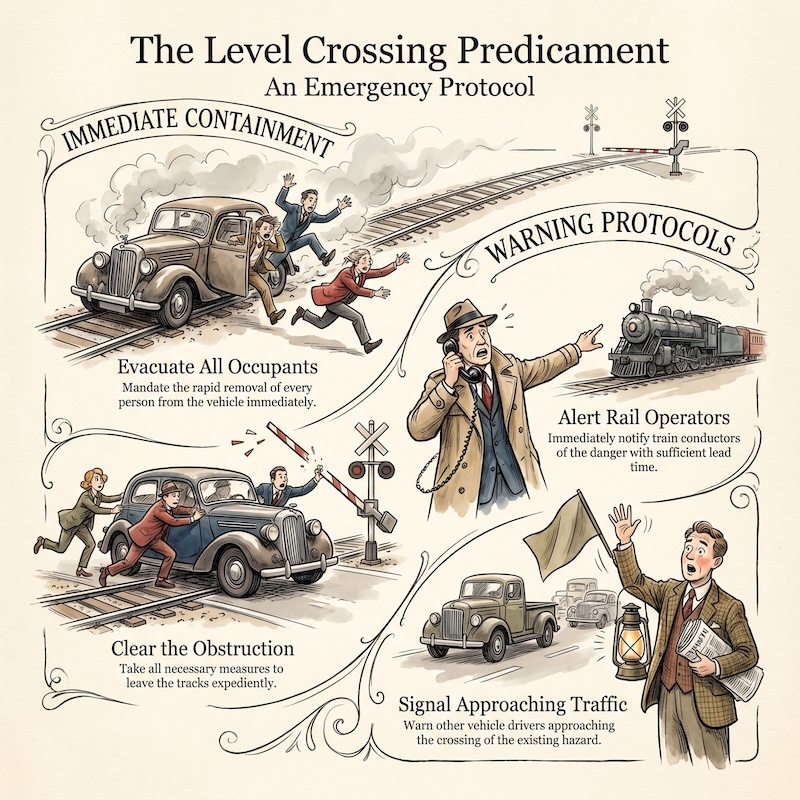
Stopping a vehicle at a level crossing, drawbridge or tunnel is one of the topics in the Driving maneuvers block of the Spanish DGT theory. Overtaking, changes of direction, stopping, parking, lighting and warnings. Understanding this section well helps you answer the theory-exam questions on this topic with confidence.
In simple terms, this point of the DGT theory establishes that when a vehicle is stopped at a level crossing for reasons of force majeure or its load falls inside the crossing, the driver must be obliged to take appropriate measures to quickly evacuate the vehicle's occupants and to clear the crossing as quickly as possible. If this is not achieved, the driver must immediately take all measures within his power to…
Manoeuvres are tested with practical cases; remember the correct order: observe, signal and only then carry out the manoeuvre.
When a vehicle is stopped at a level crossing for reasons of force majeure or its load falls inside the crossing, the driver shall be obliged to take appropriate measures to quickly evacuate the vehicle's occupants and to clear the crossing as quickly as possible. If this is not achieved, the driver shall immediately take all measures within his power to ensure that both the drivers of vehicles travelling on rails and the drivers of other approaching vehicles are warned of the existence of the danger in sufficient time.
🔗 Read the official text on the BOE (Spanish General Traffic Regulations)❓ Frequently asked questions
What is stopping a vehicle at a level crossing, drawbridge or tunnel?
Does this topic appear in the DGT theory exam?
Where is it regulated (Article 97 (1))?
🚦 Practise with DGT tests
Already studied the theory? Test yourself with official exam-style questions.
📝 Start with TraficoTest