

Mode and form of execution is one of the topics in the Driving maneuvers block of the Spanish DGT theory. Overtaking, changes of direction, stopping, parking, lighting and warnings. Understanding this section well helps you answer the theory-exam questions on this topic with confidence.
In practice, this comes down to the following:
- When the distance between the vehicle and the opposite edge of the roadway or a longitudinal marking on it indicating that crossing is prohibited is less than three metres or, in any case, when it does not allow the…
- When another vehicle that is properly stopped or parked is prevented from joining the traffic.
- When the normal use of the exit or access to a building by people or animals, or by vehicles in a correctly marked ford, is obstructed.
- When the normal use of lowered steps for the physically disabled is hindered.
- When carried out on medians, separators, islands or other traffic channelling elements.
- When the turn authorized by the corresponding signal is prevented.
In short, the rule makes sure every road user knows what to expect in this situation.
Manoeuvres are tested with practical cases; remember the correct order: observe, signal and only then carry out the manoeuvre.
Stops or parking in dangerous places or places that seriously impede traffic are considered to be those that constitute a risk or obstacle to traffic in the following cases:
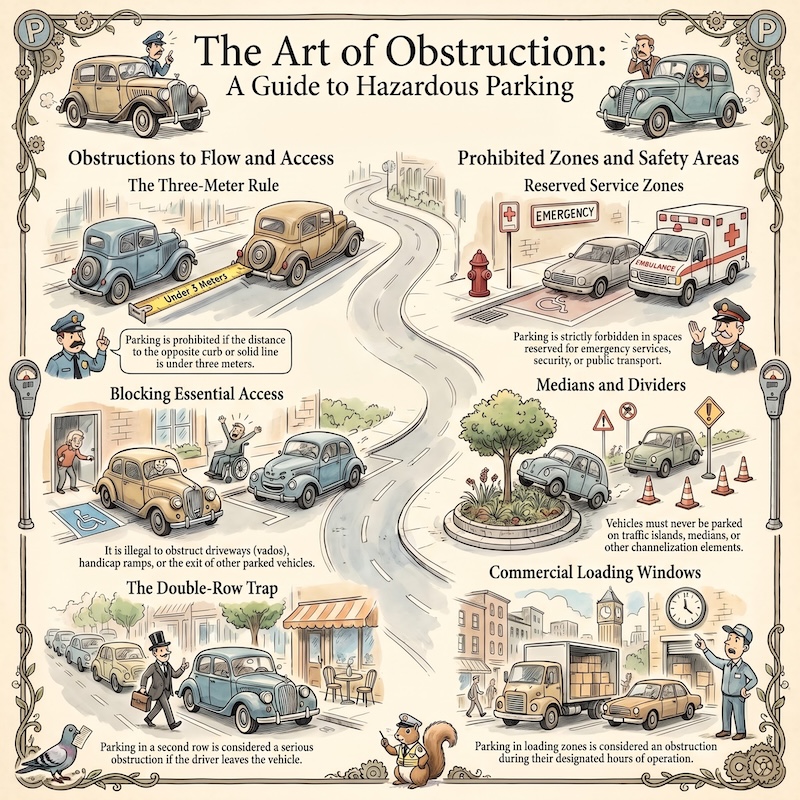
- When the distance between the vehicle and the opposite edge of the roadway or a longitudinal marking on it indicating that crossing is prohibited is less than three metres or, in any case, when it does not allow the passage of other vehicles.
- When another vehicle that is properly stopped or parked is prevented from joining the traffic.
- When the normal use of the exit or access to a building by people or animals, or by vehicles in a correctly marked ford, is obstructed.
- When the normal use of lowered steps for the physically disabled is hindered.
- When carried out on medians, separators, islands or other traffic channelling elements.
- When the turn authorized by the corresponding signal is prevented.
- When parking takes place in an area reserved for loading and unloading, during hours of use.
- When parking is done in double row without a driver.
- When parking is done at a public transport stop, which is signposted and delimited.
- When parking is carried out in spaces expressly reserved for emergency and security services.
- When parking is carried out in prohibited spaces on public roads designated as preferential attention, specifically signposted.
- When parking is done in the middle of the road.
- Stops or parking areas that, without being included in the previous paragraphs, constitute a danger or seriously impede the traffic of pedestrians, vehicles or animals.
❓ Frequently asked questions
What is mode and form of execution?
Does this topic appear in the DGT theory exam?
Where is it regulated (Article 91 (2))?
🚦 Practise with DGT tests
Already studied the theory? Test yourself with official exam-style questions.
📝 Start with TraficoTest