

🔧 What are special vehicles?
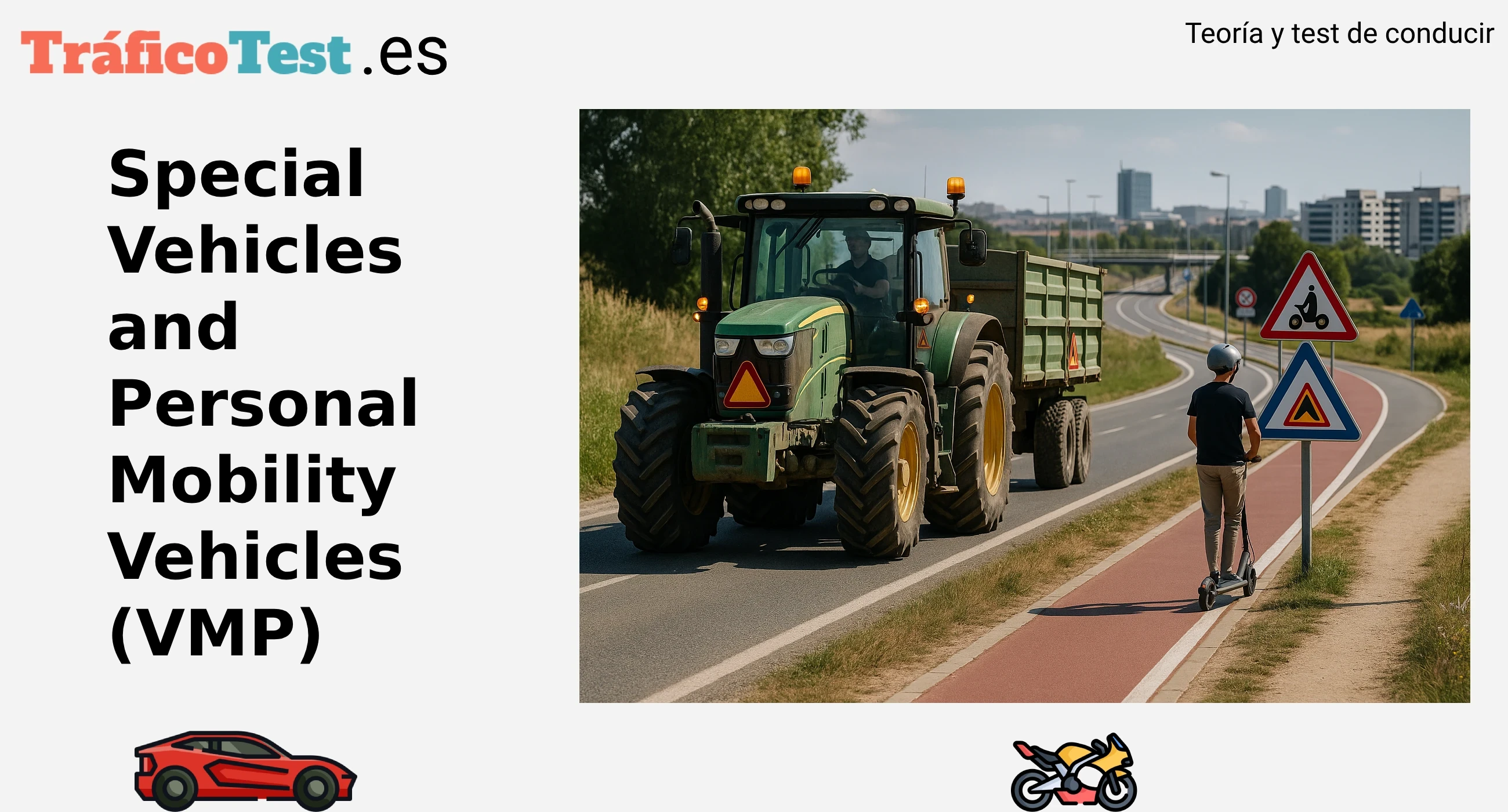
Special vehicles are those designed to carry out construction work or agricultural/livestock services. They may have their own propulsion or not (e.g., trailers) and, due to their particular features, may exceed the usual maximum masses and dimensions.
- 🚧 Construction vehicles and machinery
- 🀀Tractors and agricultural implements
📏 Masses and dimensions
They are not subject to the general mass/dimension rules, but they do have restrictions for travelling on public roads. There are two key measurements:
- 🔹 Actual width: the width of the stationary vehicle
- 🔹 Circulation width: used to determine if it may use public roads
📝 Registration and permits
To travel on public roads, they must be registered with the relevant Traffic Office and carry:
- 📄 Registration certificate
- 🛠️ Vehicle inspection card
- 🔐 Special authorization if they exceed mass or dimension limits
🚦 Required licences
- 👨🌾 Agricultural: depends on mass and number of passengers
- 🏗️ Non-agricultural: also depends on the vehicle’s maximum authorized speed
💡 Lights and technical equipment
Special vehicles must meet specific conditions:
- 🔸 Work lights, clearance/marker lights, position, dipped, main beam and brake lights
- 🔸 Warning beacons/signals V-2, V-4, V-5 and reflective panels V-20 if the load projects
- 🔸 🐀No front license plate is required
🚗 Driving rules
- 🏙️ In towns: keep to the right as appropriate for the destination
- 🌄 Outside built-up areas: use the shoulder if MAM < 3,500 kg
- 🛣️ On motorways/dual carriageways: only if they can exceed 60 km/h
- ⛔ No overtaking if travelling in parallel would exceed 15 seconds or 200 m
🚦 Maximum speeds
- 👞 Walking pace when accompanied on foot
- 🐢 25 km/h: without brake signal or when towing
- 🕒 40 km/h: in general
- 🚀 70 km/h: with authorization and if capable of more than 60 km/h
📋 Special rules
When travelling they must maintain:
- ↔️ A minimum separation of 50 metres
- 📍 Parking always off the carriageway and shoulder
- 🔔 V-2 amber beacon if travelling below 40 km/h
🛴 Personal Mobility Vehicles (VMP)
VMPs include electric scooters, unicycles or Segways that provide efficient urban mobility 🚦.
📐 Basic characteristics
- 🛵 Electric propulsion
- 👤 For a single person
- 🚫 Not intended for people with reduced mobility
- 💨 Speed between 6 and 25 km/h
⛔ Prohibitions
- 🚷 No riding on pavements (the municipal by-law decides on other pedestrian areas), nor on motorways, dual carriageways, through roads (travesías), interurban roads or urban tunnels — except on cycle lanes, cycle paths and roads closed to motor traffic — nor in HOV (VAO) lanes (since 1 October 2026, RD 518/2026)
- 🔞 Minimum age 15 across Spain; arm signals are compulsory for every manoeuvre, lights must be on, and at night or in low visibility a luminous or reflective element visible from 150 m is required
- 📵 No mobile phone use, headphones, or riding under the influence of alcohol/drugs
⚙️ Technical requirements
- 🛎️ Bell
- 💡 Lights and reflectors
- 🛑 Brakes
- ⛑️ Helmet compulsory (homologated or certified) since 1 October 2026 (RD 518/2026), fine €200; third-party liability insurance is also strongly recommended
💸 Common penalties
- 🍻 Alcohol or drugs: €500–€1,000 and vehicle immobilized
- 📱 Mobile phone use: €200
- 🀀Headphones or lack of lighting/helmet: €200
📌 Conclusion
Special vehicles and VMPs have specific rules adapted to their technical characteristics and intended use. Knowing them is essential to ensure road safety and avoid penalties.
Take the test


