

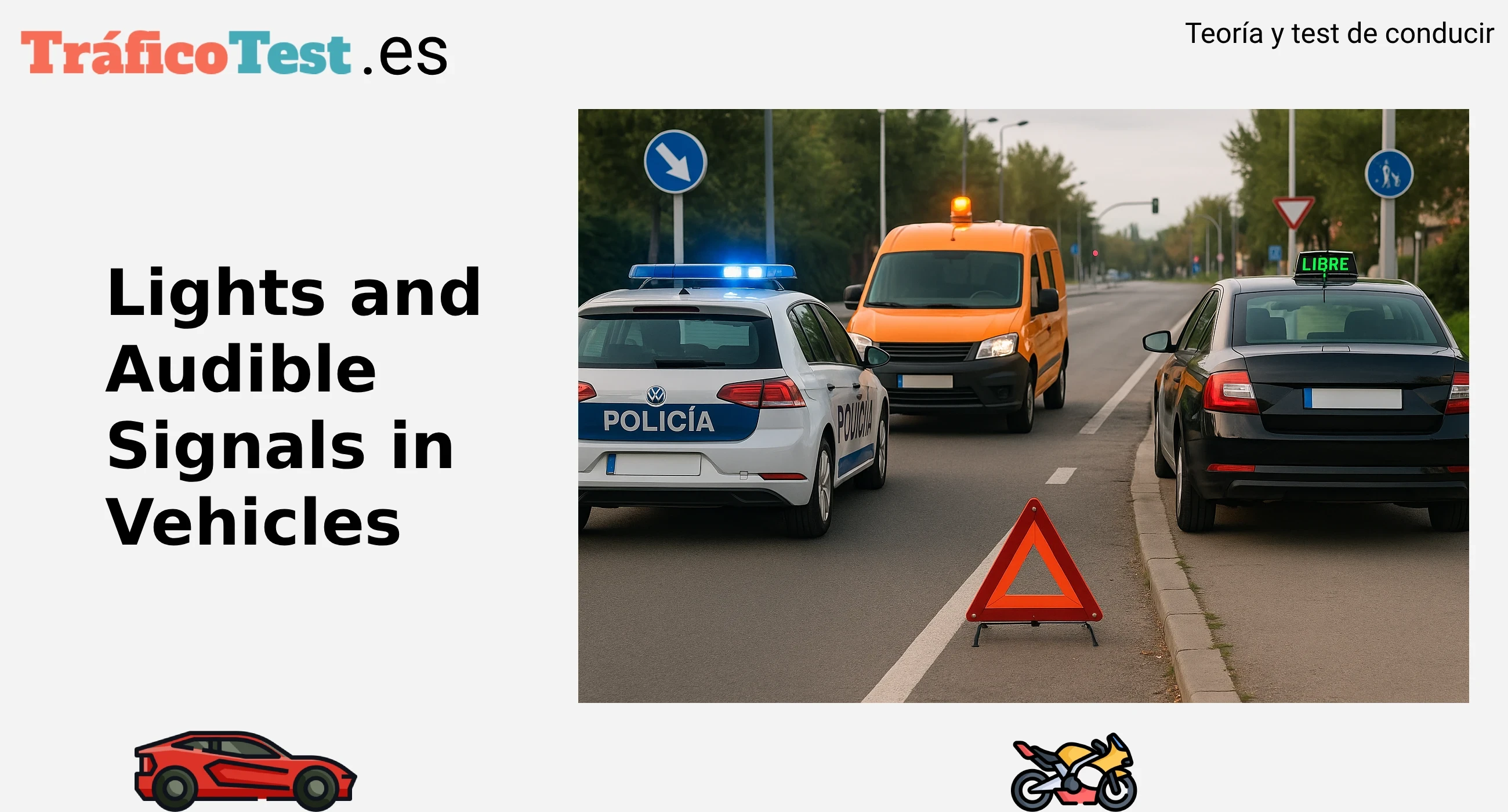
🚨 1. Light signals on priority vehicles
Priority vehicles (🚑, 🚓, 🚒) use rotating blue or amber lights to warn of their presence. They must be on urgent service and may also use audible signals (sirens).
🟡 Amber: for firefighters, ambulances, civil protection.
- Minimum visibility of 50 metres in all directions.
- Motorcycles: light mounted at the rear with a telescopic mast.
- Use without sound if there is no danger to other road users.
🚧 2. Light signals on roadworks and special-service vehicles
Vehicles such as tow trucks 🛻, sweepers, or special convoys 🚜 must use a amber rotating light (V-2) visible from 100 metres. They must also drive with dipped-beam headlights on.
| Vehicle type | Use of the light | Conditions |
|---|---|---|
| Tow trucks | When they obstruct traffic | 360° visible, 100 m |
| Roadworks or services | When they pose a hazard | Throughout the job |
| Special vehicles | From the moment they enter a motorway/expressway | Until reaching the work site |
🚖 3. “Free” indicator light on taxis
Taxis must carry a non-dazzling green light on the front-right exterior, visible from all angles. It indicates that the taxi is available for hire.
💡 4. Taximeter lighting
The taximeter must be illuminated when a trip begins (flag drop) so the user can see the fare at all times.
🔺 5. Advance danger-warning device
All motor vehicles except motorcycles must carry two reflective triangles approved by the DGT.
- Placement: one in front and one behind the vehicle (except on one-way roads).
- Distance: at least 50 m from the vehicle, visible from 100 m.
🔊 6. Audible signals
All motor vehicles must have a horn that emits a continuous, non-harsh sound. 🚲 Bicycles must have a bell (no other type of audible signal is permitted).
✅ Permitted: intermittent horn use in imminent danger or on roads with sharp bends.
Take the test


