

1. What are wheels? ⚙️
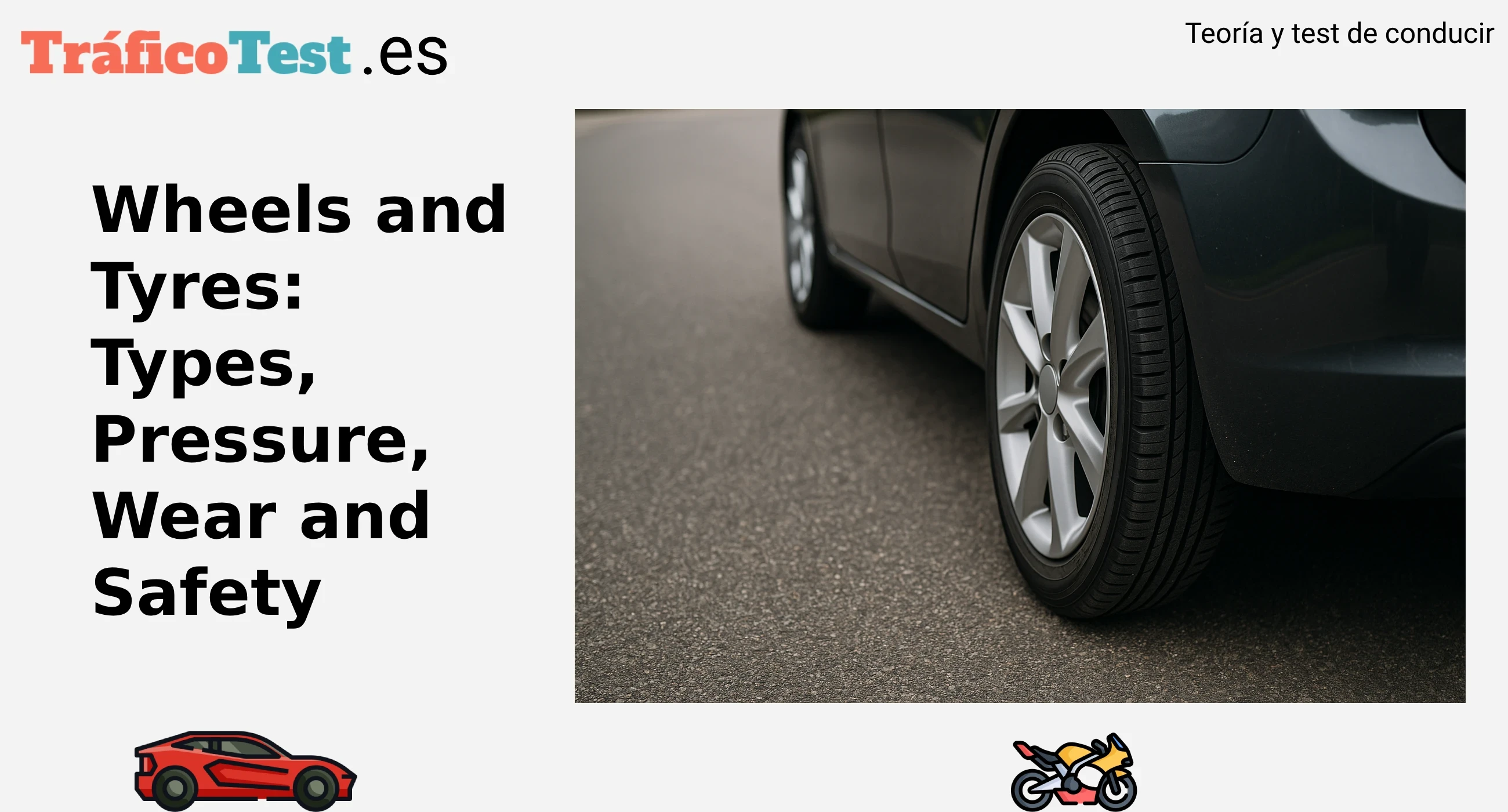
Wheels are the vehicle’s point of contact with the ground. They perform fundamental functions: they steer, propel, and stop the vehicle. They are fitted with tyres, which must have visible tread and show no damage.
🔧 Main functions of wheels:
- Transmit traction and braking.
- Absorb shocks and provide comfort.
- Dissipate heat from the brakes.
- Support the vehicle’s weight and load.
2. The rim 💠
The rigid (usually metal) part of the wheel on which the tyre is mounted. It should be light yet strong and free from rust, deformation, or damage.
3. The tyre 🛞
An air-inflated elastic structure that absorbs road irregularities. It is the vehicle’s only contact with the roadway, so proper maintenance is key to safety.
🔍 Tyre components:
| Component | Function |
|---|---|
| Tread | Grip and water evacuation |
| Sidewalls | Transmit steering inputs |
| Beads | Secure the tyre to the rim |
| Carcass (casing) | Distributes the load |
🌀 Types of tyres:
- Radial: More modern, less deformation, better grip.
- With or without inner tube: Tubeless tyres are safer in the event of a puncture.
4. Tyre grip and tread 🚘
The tread channels water away and helps prevent aquaplaning. When tread depth is less than 1.6 mm, tyres must be replaced.
| Condition | Effect on grip |
|---|---|
| Dry pavement | Maximum grip |
| Wet pavement | Reduced grip, risk of skidding |
| Snowy or icy pavement | Use special tyres (M+S) is necessary |
5. Inflation pressure ⛽
Incorrect pressure can cause premature wear, poorer stability, and higher fuel consumption. Check pressure when cold using a gauge.
- Low pressure: wear on the shoulders.
- High pressure: wear in the centre, less comfort.
- Uneven pressure: irregular braking and tracking.
6. Wheel balancing ⚖️
Prevents vibrations that damage the suspension. Done with lead weights on the rim.
7. Tyre wear 🧼
- Hard braking and high speeds accelerate wear.
- Wear increases in summer and with overloading.
- Visual indicators warn when the legal wear limit has been reached.
8. Tyre replacement 🔄
They should be replaced with tyres authorised by the manufacturer, with the same characteristics on all four wheels.
9. Blowout and how to respond 🚨
In the event of a blowout:
- Do not brake sharply.
- Hold the steering wheel firmly.
- Reduce speed smoothly.
10. Changing a wheel 🧰
- Park off the carriageway.
- Warn other road users and put on a reflective vest.
- Loosen the nuts, raise with the jack, change the wheel.
- Retighten and lower the vehicle.
11. Spare wheel 🔧
Mandatory in passenger cars and light trucks. It must be in good condition and accompanied by tools (jack, wrench, etc.).
Take the test


