

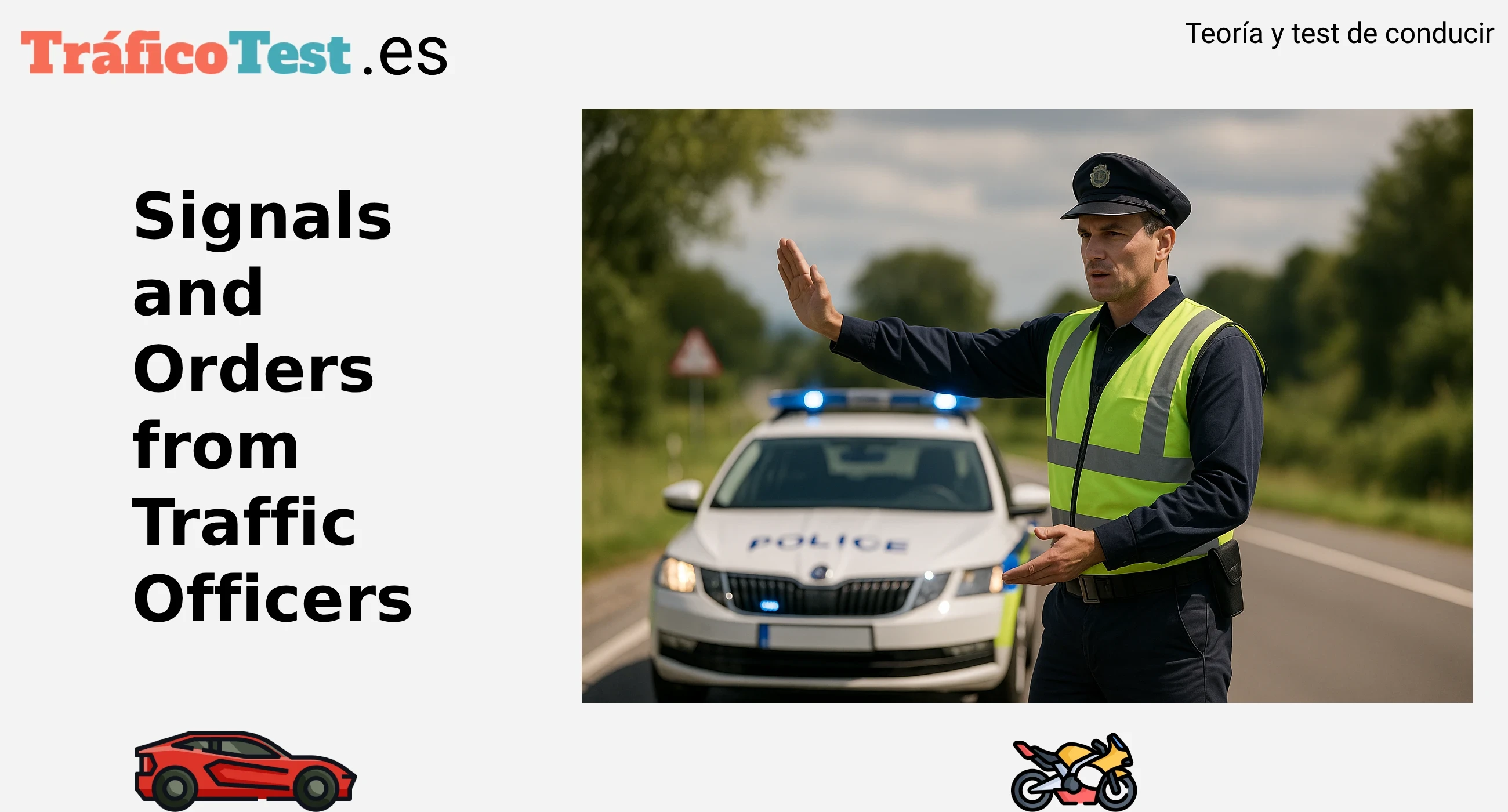
Traffic officers play a key role in regulating traffic. Their orders are mandatory and take priority over any other signal or rule, even if they contradict it. 🚨
🔢 1. Types of officers’ signals
- 👁️🗨️ Optical signals (with the arm or a light)
- 🔊 Acoustic signals (whistle or loudspeaker)
In the absence of officers, military police, roadworks personnel, or school patrols may control traffic. 👷♂️👮♀️
🖐️ 2. Hand/arm signals
| 🚨 Signal | 📘 Meaning |
|---|---|
| Arm raised vertically | ✋ All vehicles must stop before the intersection. |
| Arms extended horizontally | 🚫 Stop for those approaching from the directions the arms block. |
| Arm moving up and down | 🔽 Mandatory speed reduction. |
| Red or yellow light being waved | 🔦 Order to stop for the road users to whom it is directed. |
🔉 3. Acoustic signals
- 📢 Short, frequent blasts: Mandatory stop.
- 📢 Long blast: Proceed / resume movement.
🚓 4. Orders from police vehicles
Officers may issue orders from their vehicle using loudspeakers, lights, or flags. Examples:
- 🚩 Red flag: Roadway temporarily closed.
- ✅ Green flag: Traffic reopened.
- ⚠️ Yellow flag: Danger—use extreme caution.
- 💡 Forward-facing flashing red or yellow light: Immediate stop of the vehicle behind the police car.
- 🖐️ Arm extended downward at an angle: Stop on the right-hand side.
🦺 5. Retroreflective equipment
Officers must wear high-visibility, reflective garments (vests, armbands, belts, etc.) so they are visible from at least 150 meters. 📏
These garments are mandatory both day and night for:
- 🚔 Traffic officers
- 🚧 Roadworks personnel
- 👮 School patrols
- 🚑 Civil protection
Take the test


