

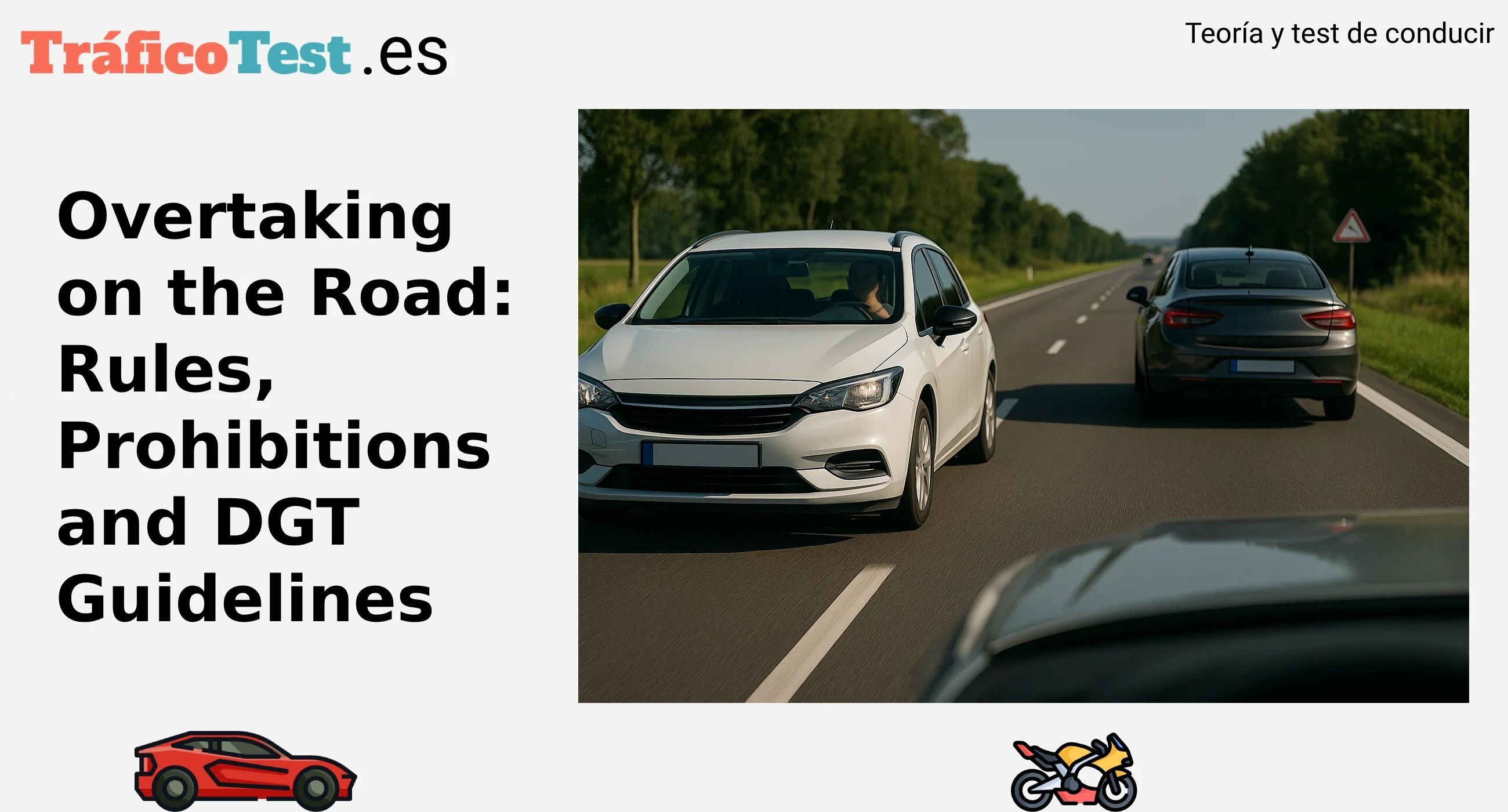
Overtaking means passing another vehicle that is ahead of you and moving more slowly, provided both are in motion. It is a complex and dangerous maneuver that requires attention and strict compliance with the rules. ⚠️
🔁 1. Performing the overtaking maneuver
🧠 1.1 Before overtaking
- 🚘 Keep a safe following distance
- 👁️ Check forward visibility
- ⚙️ Select the appropriate gear
- ❌ Do not overtake if the vehicle ahead is already at the maximum permitted speed
- 📏 Ensure there is enough space to return to the right lane
⛔ 1.2 Prohibited situations
You must not overtake if:
- 🚫 Sign R-305 or R-306 is posted
- 🚷 There are solid lines on the roadway
- 🚥 There is a traffic signal with a red “X”
- 🚧 There are channelizing devices (cones, flags, etc.)
- 🌫️ Visibility is reduced by fog, rain, smoke, or sun glare
- 🛑 In places such as sharp bends, level crossings, or tunnels
💡 1.3 Signaling the maneuver
Overtaking must be warned with:
- 🔈 Audible signals outside built-up areas
- 💡 Turn signals and low beams (dipped headlights)
- ✋ Extended arm hand signal or the left turn indicator
🚀 1.4 During overtaking
- 🛣️ Do it on the left without driving onto the shoulder
- 📏 Keep a minimum distance of 1.5 meters when passing pedestrians, bicycles or groups of cyclists, mopeds, personal mobility vehicles, animals or animal-drawn vehicles; if the road has more than one lane per direction a complete lane change is compulsory, and outside built-up areas you must also drive at least 20 km/h below the road limit (since 1 October 2026, RD 518/2026)
- 🌙 At night use low beam to avoid dazzling
↩️ 1.5 After overtaking
- 👀 Check the right mirror
- 🚨 Signal with the right indicator
- 🔄 Safely return to the right lane
🤝 1.6 Behavior of the overtaken vehicle
- 🚧 Keep to the right edge
- 📉 Do not increase speed
- 🚚 Large vehicles should facilitate the maneuver
- 🌙 Use high beams until there is a risk of dazzling
⚠️ 1.7 Behavior of oncoming traffic
Maintain your trajectory, avoid accelerating, and facilitate safe overtaking. 🚗↔️🚗
📚 2. Other types of overtaking
➕ 2.1 On three-lane roads
Use the center lane with extreme caution and make sure it is not occupied. 🛣️
🏙️ 2.2 On multi-lane roads outside built-up areas
Only the lane adjacent to the right may be used. There is no need to enter the opposite direction.
➡️ 2.3 Overtaking on the right
Permitted in exceptional cases:
- 🚗 The other vehicle is turning left
- 🚋 Passing trams on the right
- 🏙️ On urban roads with 2 or more lanes per direction
🚫 3. Maneuvers that are not considered overtaking
- 🚧 Passing a stopped vehicle (breakdown, accident or an emergency, roadside-assistance, maintenance or traffic-management service): keep at least 1.5 m of clearance (using the opposite side of the road if necessary) and drive at least 20 km/h below the road limit (art. 88 RGC, since 1 October 2026, RD 518/2026)
- 🚴♀️ Passing cyclists within the same group
- 💡 Always take extra care if it involves occupying another lane
📝 Conclusion: Overtaking requires maximum attention, good visibility, and knowledge of the rules. It’s always better to lose a few seconds than to risk your life. 🛑


