

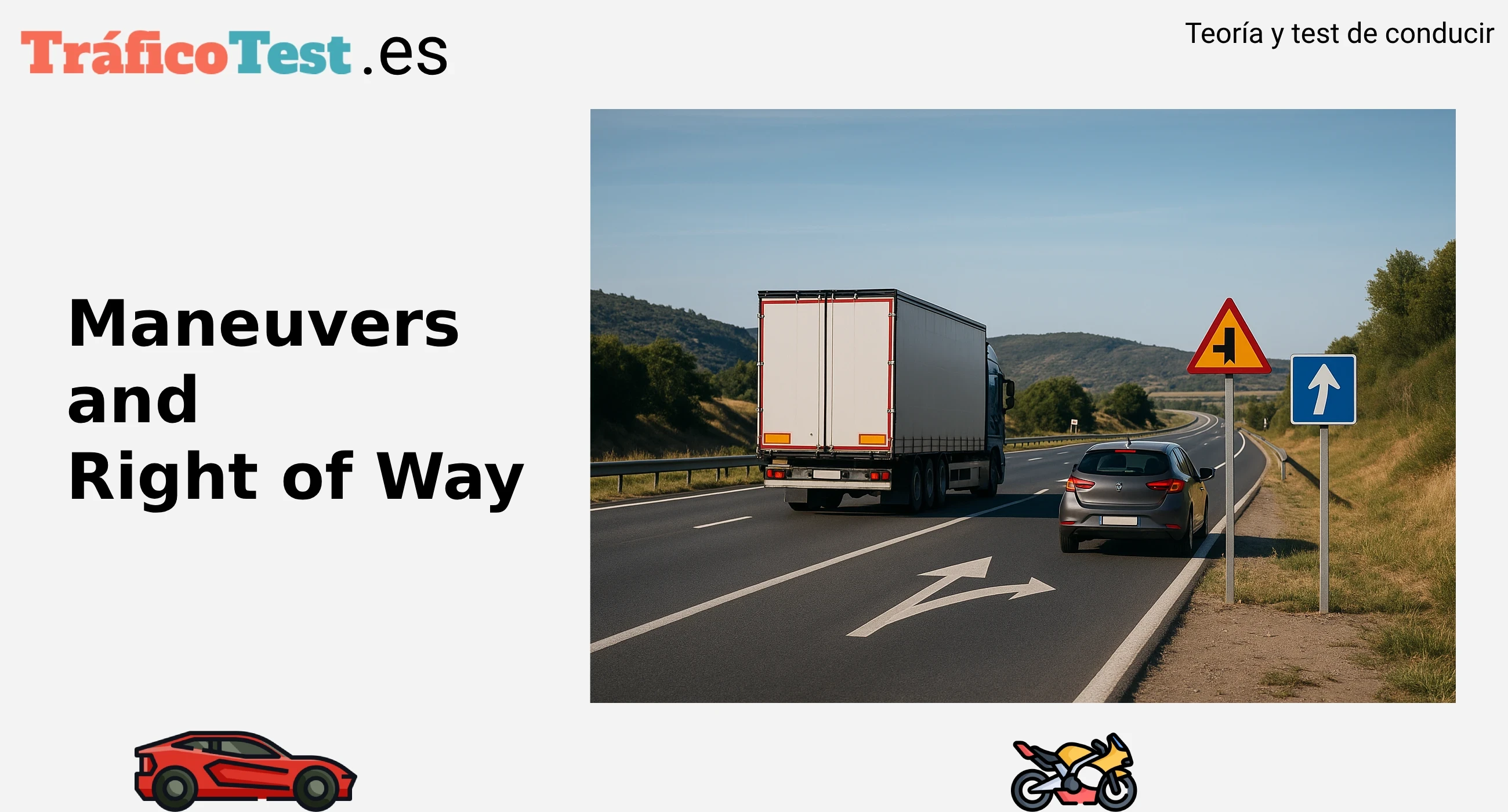
1️⃣ Maneuvers
🚙 1.1 Merging into traffic
- ✅ Yield to those already on the road.
- 👍 Those already traveling should, if possible, facilitate the merge.
- 📈 On acceleration lanes:
- Check that it’s safe.
- Yield if necessary.
- Accelerate toward the end of the lane to match speed.
↔️ 1.2 Lateral movement (lane change)
- 📣 Signal with the indicator or by hand.
- 🔍 Check that it’s safe before executing and again when finishing.
⏩ 1.3 Overtaking
- 🚗 Travel at a clearly higher speed than the vehicle being overtaken.
- 🚴♂️ When overtaking cyclists (a group counts as a single unit), pedestrians, mopeds, e-scooters, animals or animal-drawn vehicles: leave at least 1.5 m on any road; if the road has more than one lane per direction, a complete lane change is compulsory; outside built-up areas you must also reduce your speed by at least 20 km/h below the road's limit (since 1 October 2026, RD 518/2026).
- ➡️ Overtake using the adjacent lane or the oncoming lane if safe.
- 🚧 When passing a vehicle immobilised on the carriageway (breakdown, accident, emergency, roadside-assistance, maintenance or traffic-management service): keep at least 1.5 m lateral distance, even if you must use the opposite side of the road, and reduce speed by at least 20 km/h below the limit (art. 88 RGC, since 1 October 2026, RD 518/2026).
👤 Duties of the vehicle being overtaken:
- 📉 Do not increase speed.
- 📏 Keep close to the right edge.
- 🚛 If it’s a heavy vehicle: indicate it’s safe to pass with the right indicator or a hand signal.
⛔ Overtaking prohibited:
- 🚫 When visibility is insufficient.
- 🚷 At pedestrian or cyclist crossings.
- 🚧 In tunnels with only one lane per direction.
- 🛤️ At level crossings (except two-wheeled mopeds).
- 🚦 At intersections without a priority sign.
🔴 Related signs:
- 🛑 No overtaking: applies to all (except two-wheeled motorcycles if they don’t enter the opposite lane).
- 🚛 No overtaking for trucks (>3,500 kg): does not apply to buses.
🔄 1.4 Changes of direction
- ⚠️ If the vehicle’s size prevents a normal turn, proceed with utmost caution.
- 📉 Deceleration lane: reduce speed once inside the lane.
🔙 1.5 Reversing
- 🚫 Prohibited except:
- When moving forward is impossible,
- Or for stopping, parking, or merging maneuvers.
- ⚠️ Maximum of 15 m and never enter an intersection.
- ⛔ Totally prohibited on motorways and expressways.
🅿️ 1.6 Immobilizations
| Type | Duration | Conditions |
|---|---|---|
| 🚫 Stop (forced halt) | — | Not a maneuver |
| ⏱️ Standing (brief stop) | <2 min | Driver remains in the vehicle |
| 🚗 Parking | Unlimited | Vehicle immobilized |
🆘 Emergency stop:
- 📍 Pull onto the shoulder if possible.
- 🚨 Signal: hazard lights, position lights, marker lights, and the connected V-16 beacon (which replaced warning triangles on 1 January 2026).
- 🦺 Wear a reflective vest when exiting.
- ⬅️ Exit on the right-hand side.
🚇 In tunnels:
- 📴 Switch off the engine.
- 🚨 Use position and hazard lights.
- 🚷 Leave via the nearest refuge.
- 🔥 In case of fire: switch off the engine, leave the key, and exit opposite the fire.
🪝 Towing vehicles:
- ✅ Allowed only for broken-down vehicles.
- ⛔ Not allowed on expressways or motorways.
🅿️ 1.7 Stopping and Parking
🗺️ Depending on the type of road:
| Type of road | Conditions |
|---|---|
| Urban roads | Allowed on the carriageway or shoulder if at least 3 m are left free |
| Interurban roads | Only off the passable shoulder |
⛔ Prohibitions:
- 🚫 Where a prohibitory sign applies.
- 🚧 On bends with poor visibility.
- 🚇 In tunnels and underpasses.
- 🅿️ Double parking, driveways, sidewalks, loading/unloading zones.
- 🧑🦽 Lowered curbs or disabled spaces.
- 🚌 Public transport stops.
🔐 Securing the vehicle:
- 🛑 Switch off the engine; apply the parking brake.
- 🔐 Lock the vehicle if leaving it.
- ⬆️ On a slope: 1st gear uphill / reverse downhill.
- 🚛 Heavy vehicles: use wheel chocks or turn wheels against the curb.
2️⃣ Right of Way 🚧
🚦 2.1 At intersections (no signs)
- ➡️ Yield to the right (general rule).
- 🏆 The following have priority:
- Paved road over unpaved road,
- Vehicles already inside roundabouts,
- Motorway/expressway over merging traffic,
- Public road over private access,
- 🚋 Rail vehicles.
🚧 2.2 On narrow sections
- 🛑 Priority signs determine who must yield.
- 🔁 Without signs: the one who arrived first passes.
- 📏 If in doubt, priority goes to (in order):
- Special vehicles,
- Vehicle combinations,
- Animal-drawn vehicles,
- Passenger cars with trailers,
- 🚍 Public transport,
- 🚛 Trucks and vans,
- 🚗 Passenger cars,
- Quadricycles,
- 🏍️ Motorcycles with sidecar,
- 🚲 Bicycles and mopeds.
⛰️ 2.3 Sections with steep gradients
- 🔼 If there’s a narrowing: uphill traffic has priority,
- ⚠️ Unless the downhill vehicle reaches a turnout first.
🌉 2.4 Crossing bridges or narrow works
- 📍 Governed by signs.
- 🚛 Special vehicles must not pass each other if the bridge is < 6 m wide.
- 📏 Each vehicle needs at least 3 m of width.
📘 Source: General Traffic Regulations – DGT 2025
Take the test


