

Special rules is one of the topics in the Safety block of the Spanish DGT theory. Elements and behaviours that protect life: seat belt, helmet, restraint systems and pedestrian behaviour. Understanding this section well helps you answer the theory-exam questions on this topic with confidence.
In practice, this comes down to the following:
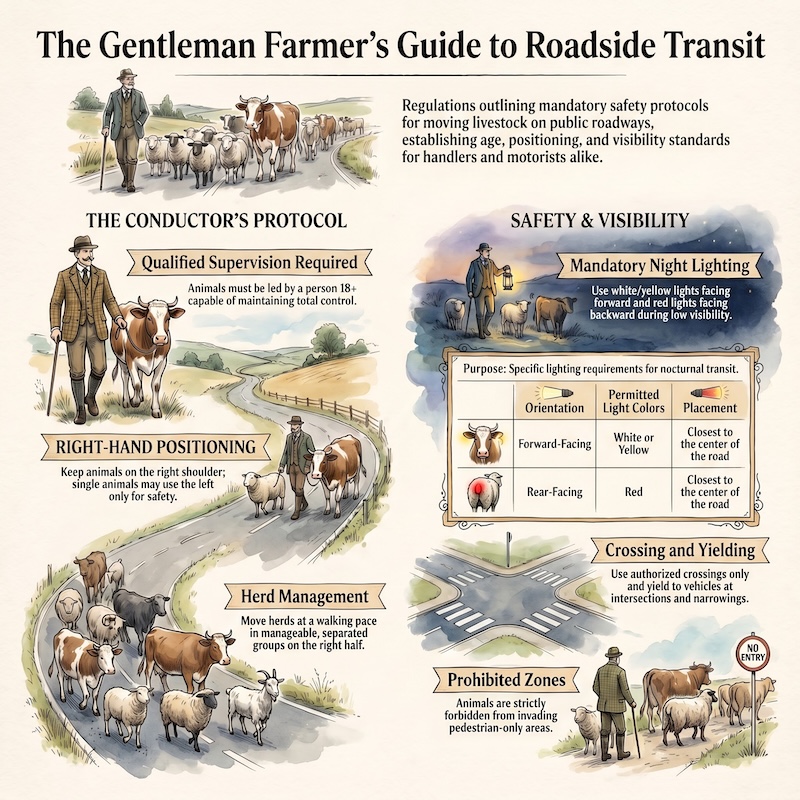
- They will not invade the pedestrian zone.
- Draft, pack or saddle animals or loose livestock must circulate on the right-hand shoulder, and if they have to use the road, they will do so as close as possible to the right edge of the road; as an exception, it is…
- They will only cross the tracks at authorized and signposted crossings or at other places that meet the necessary safety conditions.
- If they circulate at night on a poorly lit road or under meteorological or environmental conditions that significantly reduce visibility, their driver or drivers must carry lights on the side closest to the centre of…
- In narrow areas, intersections and other cases where the respective paths cross or intersect, they will give way to vehicles, except in the cases contemplated in article 66.
In short, the rule makes sure every road user knows what to expect in this situation.
Seat belt, helmet and restraint systems come with exceptions: learn both the general duty and the cases where it does not apply.
The animals referred to in the previous article must be driven by at least one person over 18 years of age, capable of controlling them at all times, who will observe, in addition to the rules established for drivers of vehicles that may affect them, the following prescriptions:
- They will not invade the pedestrian zone.
- Draft, pack or saddle animals or loose livestock must circulate on the right-hand shoulder, and if they have to use the road, they will do so as close as possible to the right edge of the road; as an exception, it is permitted to drive only one such animal on the left edge, if reasons of greater safety so advise.
(c) Animals driven in a herd or flock shall proceed at a walking pace, as close as possible to the right-hand edge of the road and in such a way that they never occupy more than the right-hand half of the roadway, divided into groups of moderate length, each with at least one driver and sufficiently separated to impede traffic as little as possible; in the event that they encounter other livestock travelling in the opposite direction, their drivers shall ensure that the crossing is made as quickly as possible and in areas with sufficient visibility, and, if this cannot be achieved by chance, they shall take the necessary precautions so that the drivers of vehicles that may approach can stop or reduce speed in time.
- They will only cross the tracks at authorized and signposted crossings or at other places that meet the necessary safety conditions.
- If they circulate at night on a poorly lit road or under meteorological or environmental conditions that significantly reduce visibility, their driver or drivers must carry lights on the side closest to the centre of the road in the number necessary to specify their location and dimensions, which must be white or yellow facing forwards and red facing backwards, and, where appropriate, may form a single set.
- In narrow areas, intersections and other cases where the respective paths cross or intersect, they will give way to vehicles, except in the cases contemplated in article 66.
❓ Frequently asked questions
What is special rules?
Does this topic appear in the DGT theory exam?
Where is it regulated (Article 127 (1))?
🚦 Practise with DGT tests
Already studied the theory? Test yourself with official exam-style questions.
📝 Start with TraficoTest