

Optical warnings is one of the topics in the Driving maneuvers block of the Spanish DGT theory. Overtaking, changes of direction, stopping, parking, lighting and warnings. Understanding this section well helps you answer the theory-exam questions on this topic with confidence.
In practice, this comes down to the following:
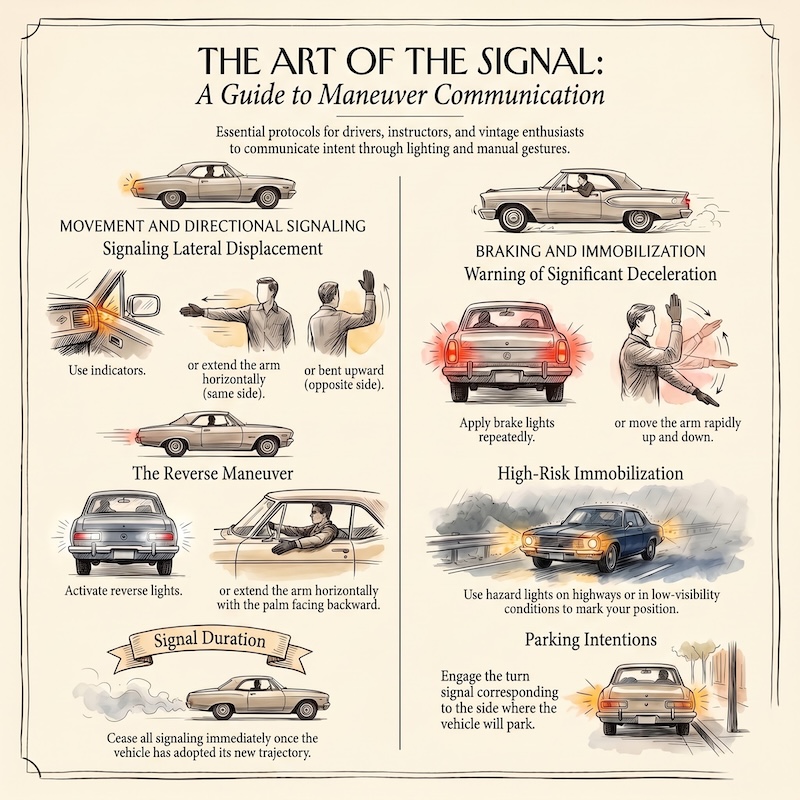
- Lateral movement will be indicated using the direction indicator light corresponding to the side towards which it is to be carried out, or the arm, in a horizontal position with the palm of the hand extended downwards…
- Reversing will be indicated by the corresponding reversing light, if equipped, or, otherwise, by extending the arm horizontally with the palm of the hand facing backward.
- The intention to immobilize the vehicle or to slow down its progress considerably, even when such actions are imposed by traffic conditions, must be indicated, whenever possible, by repeatedly using the brake lights or…
In short, the rule makes sure every road user knows what to expect in this situation.
Manoeuvres are tested with practical cases; remember the correct order: observe, signal and only then carry out the manoeuvre.
For the purposes of the preceding section, the following shall also be taken into account:
- Lateral movement will be indicated using the direction indicator light corresponding to the side towards which it is to be carried out, or the arm, in a horizontal position with the palm of the hand extended downwards, if the movement is to be towards the side that the hand indicates, or bent upwards, also with the palm of the hand extended, if it is to be towards the opposite side.
In maneuvers involving lateral movement, this is the only warning given, so the warning must end as soon as the vehicle has adopted its new trajectory.
- Reversing will be indicated by the corresponding reversing light, if equipped, or, otherwise, by extending the arm horizontally with the palm of the hand facing backward.
- The intention to immobilize the vehicle or to slow down its progress considerably, even when such actions are imposed by traffic conditions, must be indicated, whenever possible, by repeatedly using the brake lights or by moving the arm alternately up and down with short, quick movements.
When the vehicle is immobilized on a motorway or highway, or in places or circumstances that significantly reduce visibility, the presence of the vehicle must be indicated by using the emergency light, if available, and, where appropriate, the position lights.
If the vehicle is immobilized to stop or park, the direction indicator light corresponding to the side towards which the vehicle is to be immobilized must also be used, if the vehicle has such a device.
🔗 Read the official text on the BOE (Spanish General Traffic Regulations)❓ Frequently asked questions
What is optical warnings?
Does this topic appear in the DGT theory exam?
Where is it regulated (Article 109 (2))?
🚦 Practise with DGT tests
Already studied the theory? Test yourself with official exam-style questions.
📝 Start with TraficoTest