

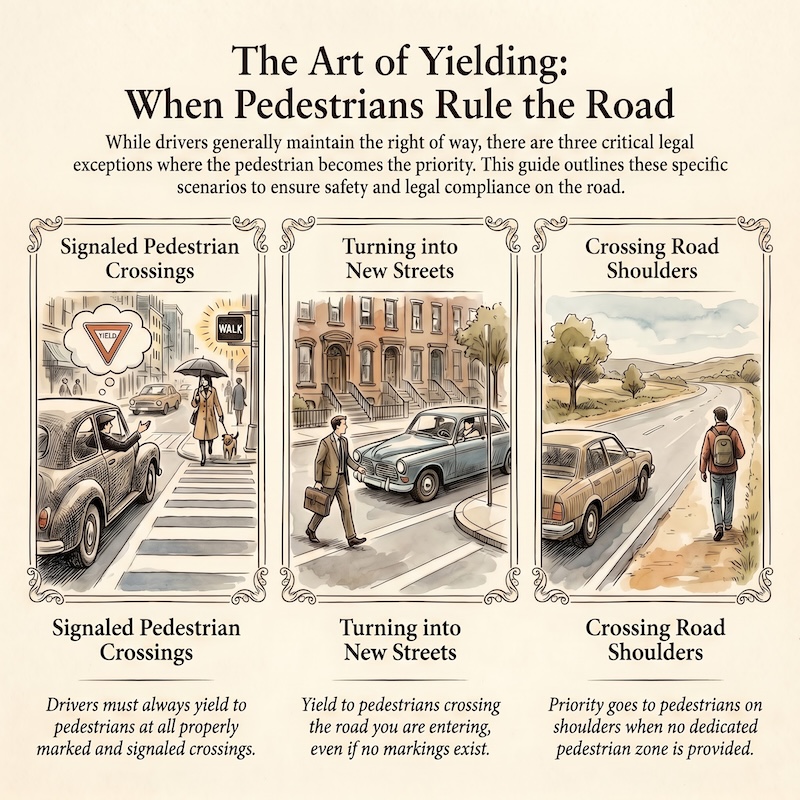
Cases in which pedestrians have priority over drivers is one of the topics in the Priority block of the Spanish DGT theory. Who goes first: right-of-way rules at junctions, roundabouts, narrow sections and special cases. Understanding this section well helps you answer the theory-exam questions on this topic with confidence.
In practice, this comes down to the following:
- At properly marked pedestrian crossings.
- When you are going to turn your vehicle to enter another road and there are pedestrians crossing it, even if there is no crossing for them.
- When the vehicle crosses a hard shoulder where pedestrians are circulating and there is no pedestrian zone.
In short, the rule makes sure every road user knows what to expect in this situation.
Priority questions use concrete situations (junctions, roundabouts, narrow sections): first work out who has right of way and why.
Pedestrians have priority of passage over vehicles in the following cases, regardless of other situations provided for in this regulation:
a) At properly marked pedestrian crossings, on pavements and in other pedestrian areas.
b) When a vehicle is going to turn to enter another road and there are pedestrians crossing it, even if there is no crossing for them.
c) When the vehicle crosses a hard shoulder on which pedestrians who have no pedestrian area are walking.
d) When pedestrians are about to board or have alighted from a public passenger transport vehicle at a stop marked as such, and are between that vehicle and the nearest pedestrian area or refuge.
e) When military units on foot, school lines and organised processions are passing.
🔗 Read the official text on the BOE (Spanish General Traffic Regulations)❓ Frequently asked questions
What is cases in which pedestrians have priority over drivers?
Does this topic appear in the DGT theory exam?
Where is it regulated (Article 65 (1))?
🚦 Practise with DGT tests
Already studied the theory? Test yourself with official exam-style questions.
📝 Start with TraficoTest