Quick table 🧾
| Item | What to know |
|---|---|
| System / Zones | 🟦 Blue • 🟩 Green (mixed/resident-favored) • 🟧 Orange (mostly residents-only) • White = free |
| Typical enforcement | Weekdays ~9:00–14:00 & 16:00–20:00, Sat 9:00–14:00 • Free evenings + Sundays/holidays |
| Time limits | Blue usually up to 2h • Green (visitors often shorter, ~1h) • Orange often residents-only |
| Typical pricing | Often ~€0.30–€1.10/hour depending on zone (approx.) |
| App to pay | Telpark (official for ORA) + meters |
| Fines | Typically ~€80–€90 (often -50% for early payment). Often a short “cancellation” window for a small fee. |
Visitor cheat-sheet ✅
| Situation | What to do |
|---|---|
| You see 🟧 Orange | Assume residents-only unless the sign explicitly allows visitors; otherwise don’t park there during enforcement. |
| You overstayed | Check the notice/meter/app — Valencia often allows fine “cancellation” within ~1 hour via a small fee. |
| You want lowest hassle | Use Telpark 📱 (GPS/zone code), and set reminders to avoid fines. |
Overview: Valencia’s public parking operates under the ORA system (“Ordenanza Reguladora de Aparcamiento”). There are typically three types of zones marked by colors on the curb: Blue, Green, and Orange. The general idea: Blue = paid parking for anyone (time-limited), Green = resident-favored (visitors allowed with restrictions), and Orange = residents-only in most cases. These zones are enforced during work hours on weekdays and Saturdays, with free parking in the evenings and on Sundays. Valencia is a bit more relaxed than Madrid/Barcelona in terms of congestion, but finding parking in central areas can still be challenging (especially in Ciutat Vella or Ruzafa).
- Zones & Rules:
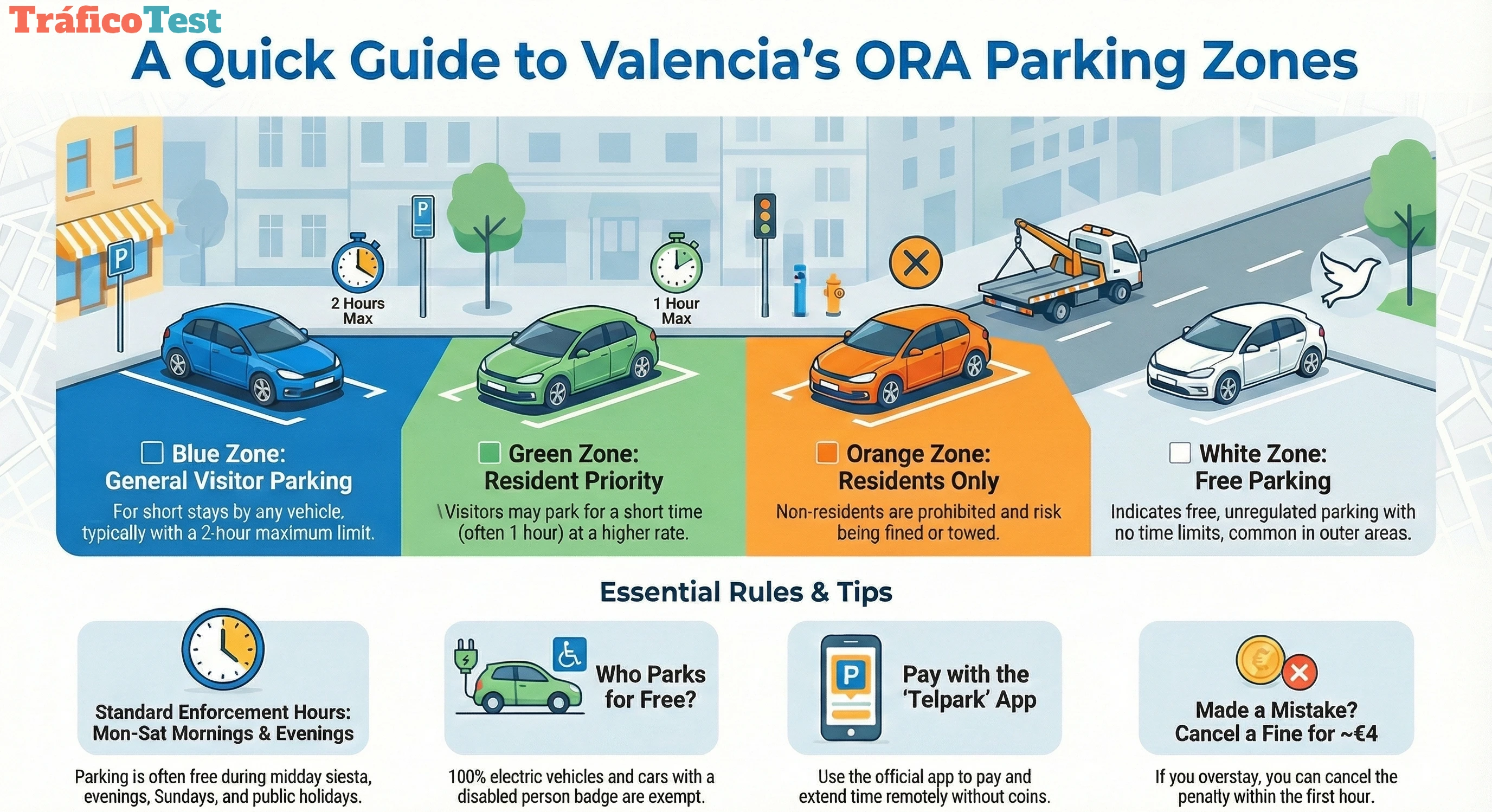
- 🟦 Blue Zone: This is the standard pay-and-display zone for any vehicle. It’s meant for short stays to ensure turnover near shops, offices, etc.. The time limit is usually 2 hours in one spot. On the street, blue zones are marked by blue painted lines and a sign with “Zona ORA” or “Zona Azul”. After paying for the max time, you can’t just reload immediately in the same spot – you’d have to move the car (the idea is you shouldn’t occupy it all day). Blue zones cover most of the city center and busy commercial streets.
- 🟩 Green Zone: In Valencia, green-painted curbs indicate “mixed” resident zones. Residents with permits can park there long-term. Non-residents may park there if they pay at the meter and typically for a shorter maximum time (often 1 hour). The rate is also a bit higher than blue for non-residents. Essentially, green gives priority to locals but doesn’t entirely exclude visitors as long as they pay and obey the time limit. Always read the sign – it will state if non-residents are allowed for a limited time (e.g. “Max 1 hora No Residentes, ticket obligatorio”). Some newer resident zones in Valencia use green, but the city also uses…
- 🟧 Orange Zone: Orange zones in Valencia are generally exclusive to residents of that neighborhood. If you are not a resident permit-holder, do not park in orange zones at the posted times – even if you wanted to pay, the meter won’t issue a ticket to non-residents there. These are typically in residential areas where street parking is scarce; they ensure locals can find a spot. Orange zones are enforced more strictly – outsiders parking there can be fined or towed quickly. (One clue: If you see an orange zone and the meter machine has no option for “no residente”, it’s residents-only.) Orange zones often allow permit holders to stay up to 7 days continuously without moving.
- White Zone: Worth noting, in Valencia (and Spain generally) white-lined curbs indicate free parking (no payment, no time limit). Many outer neighborhoods and less central streets have no ORA at all and you can park free. Keep an eye out for unmarked or white-painted curb areas if you want to avoid fees – though in the very center, these are rare.
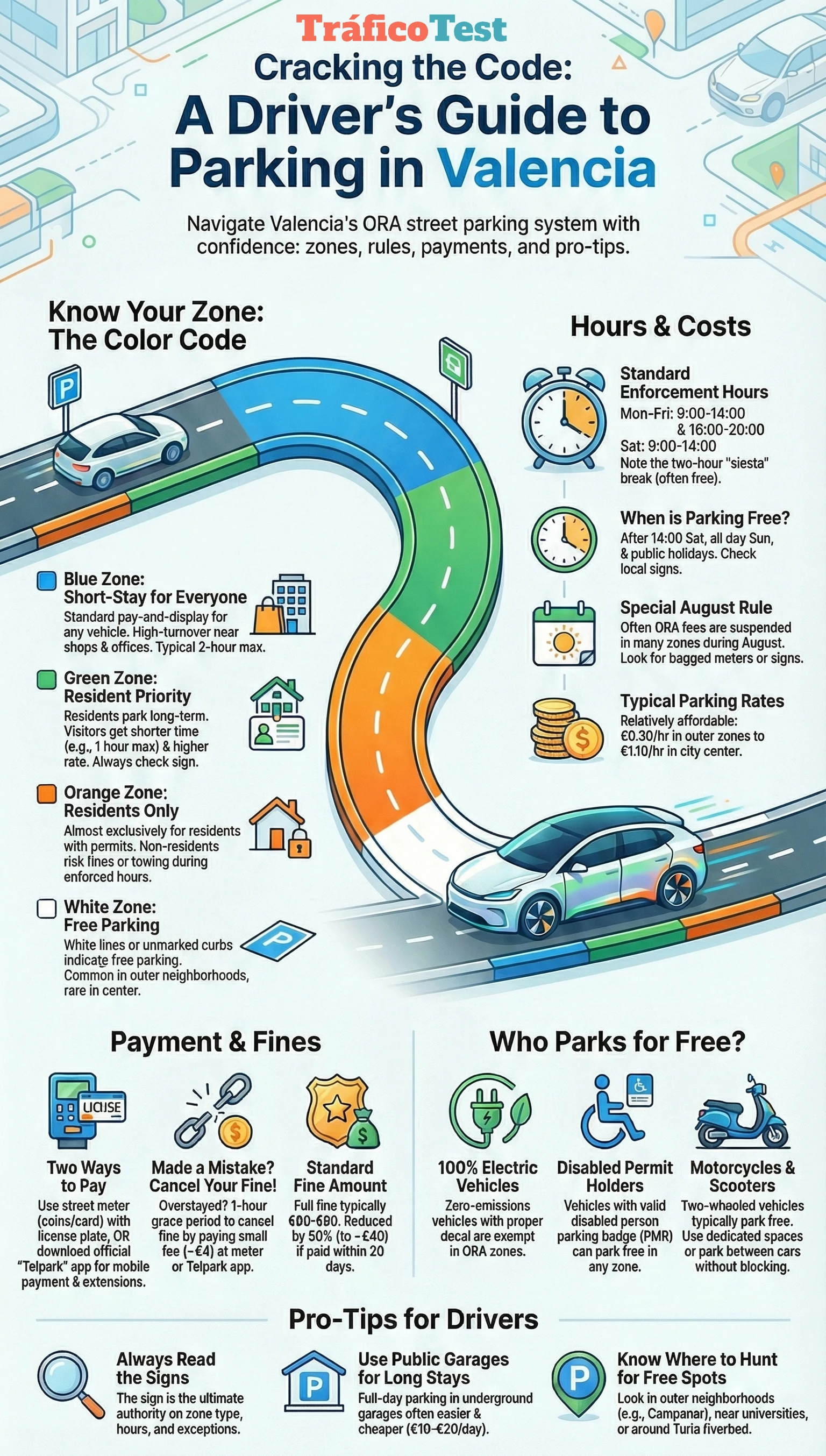
- Hours & Free Periods: The typical ORA enforcement in Valencia is Monday–Friday roughly 9:00–14:00 and 16:00–20:00, and Saturday mornings 9:00–14:00. They often pause for siesta (no charge in the early afternoon) as noted. Saturdays after 14:00, Sundays and holidays are free (no payment required). However, confirm on the specific street’s signage, as some very central areas might have continuous hours. A great thing in Valencia: during August, the city usually suspends ORA fees in many zones because of lower activity – for example, the entire month of August blue zone parking has been free in recent years. Always check local announcements or signs (they sometimes bag the meters with notice of free parking in August).
- Pricing: Valencia’s ORA fees are relatively inexpensive compared to bigger cities. The exact tariff depends on the zone and duration. Generally, it ranges from about €0.30 up to ~€1.10 per hour. For instance, the first 30 minutes might cost €0.35, 1 hour ~€0.80-€1.00, and 2 hours around €1.50-€2.00 (these are approximate). The city has a few different sub-zones (sometimes color-coded on meters as Zone A, B, C, etc.), with the busiest center being the highest rate. According to one guide, €0.30/hour in outer zones up to €1.10/hour in central areas. By law, you pay in increments (minimum 20 or 30 minutes purchase). There may also be a maximum ticket (often 2 hours for blue, 1 hour for green non-resident, 3 hours for some orange if allowed to visitors). Always check the meter: it will list the tariffs and max time.
💡 Who parks free or discounted? Several vehicle types are exempt from ORA fees in Valencia: 100% electric vehicles park free at meters (they must display the zero-emissions decal). Also, vehicles with a disabled person badge (PMR) park free in any zone. Motorcycles and scooters typically park for free as well (they should use dedicated motorcycle parking areas or park perpendicular to the curb between cars without blocking anyone). Be careful not to put a motorbike in a full car space in blue zone – you don’t have to pay, but if it looks like you’re taking a car spot, sometimes enforcement might ticket it. Hybrid vehicles (ECO) usually have to pay the normal rate (Valencia hasn’t given general discounts to hybrids, unlike some cities). Official public service vehicles, police, ambulances, etc., of course don’t pay.
- Paying for Parking: The city’s official app for mobile payment is “Telpark”. Telpark (by the company Empark) is authorized by Valencia’s council to handle ORA payments via smartphone. Many locals and visitors use it to avoid hunting for coins. Through the app, you select your zone (it will use GPS or you enter the zone code from the meter sticker) and the duration; it charges your card and your license plate is recorded as paid. You can also extend time remotely if you haven’t hit the max limit. Alternatively, you can pay at the street meter (“parquímetro”). Enter your plate number, then insert coins or card for the desired time, and it prints a ticket. Display that ticket on your dashboard. Tip: The meters in Valencia are modern and many accept credit cards or contactless payment, which is convenient if you have no coins.
⏱️ Grace period & fine cancellation: If you overstay a bit, Valencia has a user-friendly policy: within the first hour after your time expires, you can cancel the parking fine by paying a small fee (around €4) at the meter or via the app. Essentially, if you return to find a penalty notice, the meter will allow you to purchase a special ticket (“ticket de anulación”) for a fixed amount (roughly the cost of a full day or €4) to void the fine. This is great – it saves you from an €80 ticket if you act quickly. The Telpark app also supports this fine cancellation feature within the allowed time. Of course, this only applies if you overstayed or forgot to pay temporarily. If you never paid at all and many hours passed, you might be facing a full fine that can’t be undone this way.
- Resident Parking: Valencia residents can obtain a resident parking permit for their neighborhood, usually if they live in an area with green or orange zones. The city’s system has different schemes for different barrios. Generally, with a permit, a resident can park in green/orange near home either for free or for a very low flat fee. For example, one info snippet shows Orange zone residents pay €0.60 per day, or €2.80 for a week (5 days), and can even pay €10 for 20 weekdays – that covers up to 20 days, effectively €0.50/day. Green zone might be similar. Many times, the resident “permit” isn’t a physical sticker but just your plate being registered in the system. To get one, you’d go to the ORA office (Valencia’s ORA office info: Cl. Alginet 3) with proof of residence, car ownership, etc. Tourists won’t need this, but it’s good to know why some cars don’t have to buy tickets – they might belong to residents with prepaid permits.
- Fines: If you don’t pay or you exceed the time by too long, the ORA attendants (vigilantes) can issue a fine usually around €80–90 (this is treated as a minor traffic infraction). Like other cities, paying within 20 days knocks it down to ~€40. The fine is placed as a notice on your windshield, and if not paid or canceled promptly, it will be mailed to the vehicle owner. As mentioned, Valencia allows a one-hour window to cancel a fresh fine by paying the €4 cancellation fee. If you miss that, the formal fine comes into effect. It’s worth using the app’s notifications or your own timer to avoid this scenario. Serious violations (parking in handicap spot without permit, in a no-parking zone, double parking) carry higher fines and risk of towing. Valencia does tow cars for grave violations; the municipal pound (depósito) will charge towing and daily storage fees. For ORA overtime, towing is uncommon unless you’ve left the car way beyond paid time and are impeding something.
- Driving and Parking Tips:
🔸 Traffic and ZBE: Valencia has implemented a Low Emission Zone as well – older vehicles without an emissions sticker might face restrictions in the city center starting 2025. Keep an eye on local regulations if driving an older car.
🔹 Navigating ORA: The ORA zones in Valencia cover much of the central districts (Ciutat Vella, Eixample, Extramurs, etc.). If you’re visiting, it might be easier to use a public parking garage for long durations. Many garages offer flat daily rates (€10-€20/day). Some areas like around the City of Arts and Sciences have ample paid garages and also some free street parking slightly further out. During big festivals like Las Fallas, street parking is extremely difficult – consider park-and-ride or leaving the car outside the center.
🔸 Free Parking Spots: Locals know some free zones: for example, around the Palau de la Música and Turia riverbed, there are free curbside spots (though they fill quickly). The neighborhood of Campanar or near Nuevo Centro mall has free parking areas, and you can walk or take a short metro/bus to the old town. Also near universities or beaches you might find unregulated streets (e.g. parts of Cabanyal area have free parking). Just be sure it’s an actual free spot: look for the absence of colored lines.
🔹 Use Technology: Apps like Google Maps or Waze can help locate parking. There are also apps like ElParking and Parkopedia that show street parking rules and garage prices. The Telpark app itself can show you a map of ORA zones and even lets you find and reserve spaces in partner garages. Planning ahead can save time circling the block.
🔸 Watch the Signs: Always read the ORA sign on the street where you park. It will tell you the hours of payment, maximum allowed time, and which type of zone it is (azul, verde, naranja). The signage in Valencia will also indicate if, say, August is free, or if Saturday is free in that particular spot. It might also list exceptions: e.g. “Vehículos Cero Emisiones Exentos” (zero-emissions vehicles exempt from paying) or similar notes.
Take the test